
Mold Remediation Insurance Claims in Columbus, OH
Thirty years documenting mold claims for Ohio adjusters. We know what Erie, Nationwide, and State Farm need to approve your remediation — and we build that package at no charge as part of every inspection.


How Ohio Homeowners Insurance Generally Treats Mold
Only your insurance company can determine what your specific policy covers. What follows is general information about how Ohio homeowners policies typically approach mold claims — based on 30 years of working alongside Columbus adjusters. Think of it as context, not a coverage opinion. Your policy language and your carrier's review are what count.
Ohio policies commonly follow a general rule: mold resulting from a sudden event is more likely to be considered for coverage than mold from an ongoing condition — but this is not a guarantee. Every claim is reviewed on its own facts by your carrier.
✓ More Likely to Be Considered
- Burst or frozen pipe causing water intrusion
- Washing machine, dishwasher, or water heater overflow
- Storm damage (hail, wind) breaking a roof or window, allowing water in
- Sump pump failure — if water backup endorsement was purchased
- Fire suppression water that causes mold
- Accidental AC condensate line failure causing ceiling damage
✗ More Likely to Be Excluded
- Gradual leaks — a slow drip under the sink that went unaddressed for weeks or months
- Flooding from groundwater, surface water, or a storm without separate flood insurance
- Chronic basement seepage from foundation issues
- Mold from humidity and poor ventilation alone
- Damage the adjuster can tie to deferred maintenance or neglect
- Sump pump failure without water backup coverage on your policy
These are general patterns based on common Ohio policy language — not a determination of your coverage. Your carrier makes the coverage decision based on your specific policy, the facts of your loss, and their own review. iDry Columbus provides site assessment and documentation; we are not insurance agents, adjusters, or attorneys.
Columbus Seasonal Claim Patterns — What 30 Years Tells Us
Columbus mold claims follow predictable seasonal patterns. Knowing the season and event type gives us important context about the nature of the loss — and what documentation your adjuster will likely want to see.
❄️ January–February Common Claim Type
Frozen pipe bursts are among the most common mold jobs we document in Columbus. Polar vortex cycles send temperatures below zero, bursting supply lines in unheated spaces. German Village and Clintonville homes with cast-iron plumbing and exterior wall pipes are especially vulnerable. In our experience, burst pipe events are a scenario Ohio adjusters routinely review — and thorough documentation of the event timeline is what makes those reviews go smoothly.
🌧 April–May Endorsement Dependent
Sump pump failures during heavy spring rain are the second most common claim type we see across New Albany, Hilliard, and Dublin. Whether this type of loss is considered under a policy depends on whether water backup coverage was purchased as an endorsement — many Columbus homeowners don't realize their standard policy doesn't include it until they need it.
⛈ June–August Common Claim Type
Summer hail and windstorms damage roofs across Upper Arlington, Bexley, and Worthington — neighborhoods where 1950s–70s roofing inventory is aging fast. Water enters through damaged decking, mold follows in the attic within 48 hours. In our site assessments, delayed discovery is the most common documentation gap adjusters raise on storm-related mold claims.
Not sure how your situation fits? We have worked alongside Franklin County adjusters for 30 years. Tell us what happened — we will give you an honest site assessment and document what we find.
☎ Call 614-810-0000 — Free Site AssessmentWhat Columbus Adjusters Need — and Exactly What iDry Provides
Every restoration company says "we help with insurance." Here is the difference: we build a specific, adjuster-ready package before we touch a single mold spore. Columbus adjusters — Erie, Nationwide, State Farm, Grange — have reviewed hundreds of iDry documentation packages over 30 years. They know what to expect.
Time-Stamped Photographs
Sequential photos of the moisture source, affected areas, and mold growth — all with embedded timestamps that establish the timeline of the event. Columbus adjusters use photo sequence to determine whether the mold resulted from the claimed event or a pre-existing condition. We know which angles and distances Erie and Nationwide reviewers check first.
Calibrated Moisture Readings
Active moisture measurements from every affected surface, taken with calibrated meters and logged by location. These readings prove that the mold event was recent and ongoing — not an old problem that was ignored. Franklin County adjusters flag claims where moisture data is absent or inconsistent with the claimed event date.
Written Cause-of-Loss Narrative
A written account of the event sequence — when the water intrusion likely occurred, what caused it, how moisture spread, and how mold developed. This document connects your event to the covered peril language in your Ohio policy. Adjuster reviewers read this first. Vague narratives lead to delays; specific technical narratives lead to approvals.
Scope of Work — Xactimate Format
A complete remediation scope estimate produced in Xactimate — the same estimating software insurance adjusters and carriers use to evaluate claims. No translation required, no format mismatch, no adjuster asking us to resubmit. The estimate is already in the language your insurance company speaks.
Why Xactimate matters: Most restoration contractors use their own format for estimates. Insurance adjusters then have to manually translate line items and often push back. iDry Columbus scopes every remediation job in Xactimate — the industry standard adjusters already use internally. It eliminates the single biggest source of claim friction in Columbus.
Call the Contractor First, Then File the Claim
Most Columbus homeowners do this backwards — they call their insurance company first and then scramble to find documentation. Here is the right sequence. It leads to faster approvals and fewer denials.
Call iDry Columbus — Before Filing Anything
Reach us at 614-810-0000. Tell us what happened. We respond same-day across Franklin County. The 24–48 hour window after a water event is critical — both for mold development and for establishing a clean documentation timeline before anything is disturbed or dried out.
Free Inspection + Site Assessment
We walk the property, identify the moisture source, take calibrated readings, photograph all affected areas with timestamps, and give you our honest site assessment — what we found, what caused it, and what documentation we can provide. We share our read of the situation based on 30 years of working similar Columbus losses. We're not adjusters and we can't tell you what your policy covers — but we can tell you exactly what the loss looks like on the ground, and build the documentation package around that. No lab fee. No upsell. Free inspection means exactly that.
You Receive the Complete Documentation Package
Photos, moisture readings, cause-of-loss narrative, and a Xactimate-formatted scope estimate. You take this package to your insurance company — or we can communicate with your adjuster directly if that is easier. Either way, you are walking in with everything they need, in the format they already use.
File Your Claim
Contact your carrier with the documentation package in hand. For Erie, Nationwide, State Farm, and most Ohio carriers, this is all the adjuster needs to begin review. Complete documentation submitted at the time of claim filing significantly reduces back-and-forth and processing delays.
Adjuster Review
Your adjuster reviews the package. If a site visit is required, we can be on-site to walk them through our findings. Our cause-of-loss narrative speaks the language adjusters use internally — covered peril standard, event timeline, affected materials, scope necessity. Thirty years of these conversations show in every line.
Remediation Begins — Containment-First, Transparent Pricing
Once approved, we begin full mold remediation: containment barriers under negative air pressure, HEPA air scrubbing, targeted removal of affected porous materials, and EPA-registered antimicrobial treatment. Written scope before work starts. No surprises. No mid-job additions without your approval.
Your Claim Was Denied. The Mold Still Has to Come Out.
A denial does not make your home safe. The mold continues to grow, the affected area expands, and the health risk does not pause while you process the answer. iDry Columbus handles both insurance-covered and out-of-pocket jobs — same crew, same process, same transparent scope.
The Most Common Reasons Columbus Claims Are Denied
Gradual Leak Determination
The adjuster concludes the moisture source was a slow, ongoing leak rather than a sudden event. This is the most common denial reason. Strong moisture data and a clear event timeline are your best defense — and your best appeal argument if you disagree with the determination.
Flood Source Without Flood Insurance
Mold caused by surface water, groundwater, or storm flooding is excluded from standard Ohio homeowners policies. A separate flood insurance policy — typically through NFIP or a private insurer — is required. Columbus basements that flood during spring rains often fall into this category.
Sump Pump Failure, No Water Backup Coverage
Standard Ohio homeowners policies exclude sump pump overflow. The water backup endorsement — which covers this — is optional and frequently not purchased. If your basement flooded due to a failed sump pump and you do not have this endorsement, the claim will typically be denied.
Delayed Reporting or Discovery
Mold discovered weeks or months after a water event is harder to connect to the original claim. Adjusters look at whether the homeowner took reasonable steps to mitigate damage promptly. Delayed action is often characterized as allowing a preventable condition to worsen — regardless of when the original event occurred.
Out-of-Pocket Options — Clear Scope, Realistic Costs
If your claim is denied or your situation was never covered, we give you the same free inspection, same documented scope, and same transparent pricing. Most Columbus out-of-pocket mold remediation costs range from $750–$2,500 for contained single-area jobs to $3,500–$15,000 for basement and attic work. We separate necessary from optional so you control the final number.
What Columbus Homeowners Say About the Documentation Process
"Pipe burst in January. Called iDry before calling my insurance company. Best decision I made. They had everything documented before the adjuster even called me back. Claim was approved in four days. Couldn't have navigated Erie's process without their paperwork."
D. Miller — Clintonville (Homeowner)
"My adjuster had questions about the mold timeline. Curtis's team walked me through the Xactimate scope line by line. I understood what I was submitting. No guesswork, no surprises. Claim went through. The documentation package was the difference."
T. Schwartz — Upper Arlington (Homeowner)
"My claim was denied the first time — gradual leak, they said. iDry helped me build an appeal with the moisture data. Second review went through. 30 years in Columbus means they know exactly how these adjusters think."
P. Washington — German Village (Homeowner)
More From the iDry Columbus Mold Silo
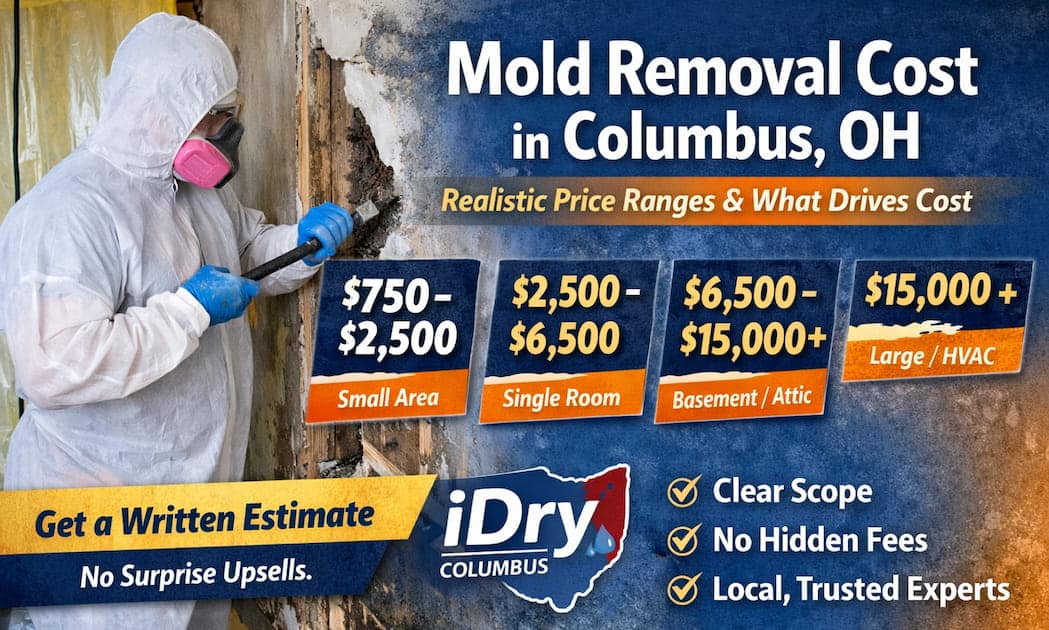
Columbus Mold Remediation Cost Guide
Realistic Columbus price ranges by scope type — small contained areas through full basement jobs. What drives cost up, what's optional, and how to read a scope estimate.
Basement Mold Remediation Columbus
Columbus basements are the most common mold job we document for insurance claims. Sump pump failure, foundation seepage, spring flooding — covered event patterns and the process.
Free Mold Inspection — Columbus, OH
The free inspection is the starting point for every insurance documentation package. No lab fee. No upsell. We find the source, measure moisture, and give you a straight scope.
Serving Columbus, Franklin County, and Surrounding Communities
iDry Columbus documents mold insurance claims for homeowners across all of Central Ohio. Thirty years of Franklin County property patterns — freeze cycles, clay soil moisture, seasonal storms — means we know how local adjusters think about Columbus claims specifically.
German Village · Clintonville · Bexley
Pre-1940 construction — frozen pipe claims most common Jan–Feb. Cast iron plumbing in exterior walls is the recurring cause-of-loss.
Dublin · Hilliard · New Albany
Finished basements with sump pump dependency. Spring rain sump failures drive the most insurance calls April–May. Water backup endorsement is critical here.
Upper Arlington · Worthington · Grandview
1950s–70s roof inventory — aging sheathing fails under summer hail. Attic mold from storm damage is the dominant insurance claim type in these neighborhoods.
Mold Insurance Claims FAQ for Columbus Homeowners
The most common questions Franklin County homeowners ask before calling us — straight answers, no hedge language.
Does homeowners insurance cover mold remediation in Columbus?
Why do insurance companies deny mold claims?
What documentation do insurance adjusters need for a mold claim?
Should I call a mold company or my insurance company first?
Does water backup coverage cover mold from a sump pump failure?
What happens if my mold insurance claim is denied?
Is black mold covered by homeowners insurance?
Do I need a mold test before filing an insurance claim?
How quickly does mold grow after water damage?
Does Erie Insurance cover mold remediation in Ohio?
Get Your Adjuster-Ready Documentation Package — Free
Tell us what happened. We respond same-day across Franklin County. The inspection is free — no lab fee, no obligation, no upsell. If photos are helpful, attach them. Wide shots are enough.
Prefer to talk? Call or text 614-810-0000.
Request a Free Inspection
2–3 minutes. We respond during business hours. Emergencies: call 614-810-0000.
☎ Call / Text 614-810-0000