
By Curtis Teets, owner and operator, iDry Columbus · Last reviewed .
Mold on Brick & Masonry — Removal, Prevention & Hidden Damage in Columbus, OH
Black, green, or white deposits on brick can be mold — or efflorescence, mildew, or soot. Each looks similar at first glance and each requires a different fix. iDry Columbus walks the visual triage and tells you when the wall is the symptom, not the problem. Call 614-810-0000 for an inspection across Columbus and surrounding suburbs.

Real Columbus brick mold guidance from Curtis Teets, owner and operator of iDry Columbus — 30+ years across German Village, Italian Village, Old Town East, Bexley, Clintonville, Dublin, Westerville, Worthington, Upper Arlington, Hilliard, and surrounding Franklin County. All work performed to IICRC S500 (water damage) and S520 (mold remediation) industry standards. Call 614-810-0000.
The First Question: Is It Actually Mold? (Or Just Efflorescence?)
Most "mold on brick" calls in Columbus turn out to be efflorescence — mineral salts pushed to the surface by moisture, not a fungal colony. The two look almost identical at first glance, but they require completely different responses. Get the ID right before you scrub anything.

What I tell folks calling about a white deposit: I've scraped enough efflorescence off Columbus basement walls to know exactly when it's not mold. The differentiator below is the call we make on every brick callout before scope of work is written.
Efflorescence — Mineral Salt Deposits
- Look: crystalline, powdery, or chalky. White only.
- Feel: gritty, granular. Brushes off as dust.
- Water test: dissolves and washes away.
- Location: moisture exit points — mortar joints, cracks, weep holes.
- What it means: water is moving through the wall and depositing dissolved calcium salts as it evaporates.
White Mold — Fungal Colony
- Look: fuzzy, cottony, or slimy. May have green, gray, or black mixed in.
- Feel: soft or web-like. Smears, doesn't dust off.
- Water test: does not dissolve. Stays put.
- Location: flat surfaces, organic dust deposits, paint or soot residue.
- What it means: the wall has been wet long enough for fungal spores to germinate and colonize organic matter on the surface.
For the broader silo overview, see our Columbus mold remediation page. If you've already confirmed mold and want testing-grade confirmation, the mold inspection child covers sampling and lab work.
Quick disambiguation note: "brick mold" sometimes refers to the wood trim profile around exterior doors and windows (a millwork term). This page is about contamination — mold growing on actual brick or masonry. Different problem entirely.
The Three-Test Confirmation — Water, Color, and Location
Three quick tests on a single deposit answer the mold-vs-efflorescence question almost every time. Run them in this order before you reach for vinegar, bleach, or a wire brush. Two minutes total.
Test 1 — The Water Spray Test
Spray a small patch with plain water from a household spray bottle. Efflorescence dissolves and washes away within seconds — the salts are water-soluble by definition. Mold does not dissolve. Fungal hyphae stay attached and may even darken slightly when wet.
Test 2 — The Color and Texture Test
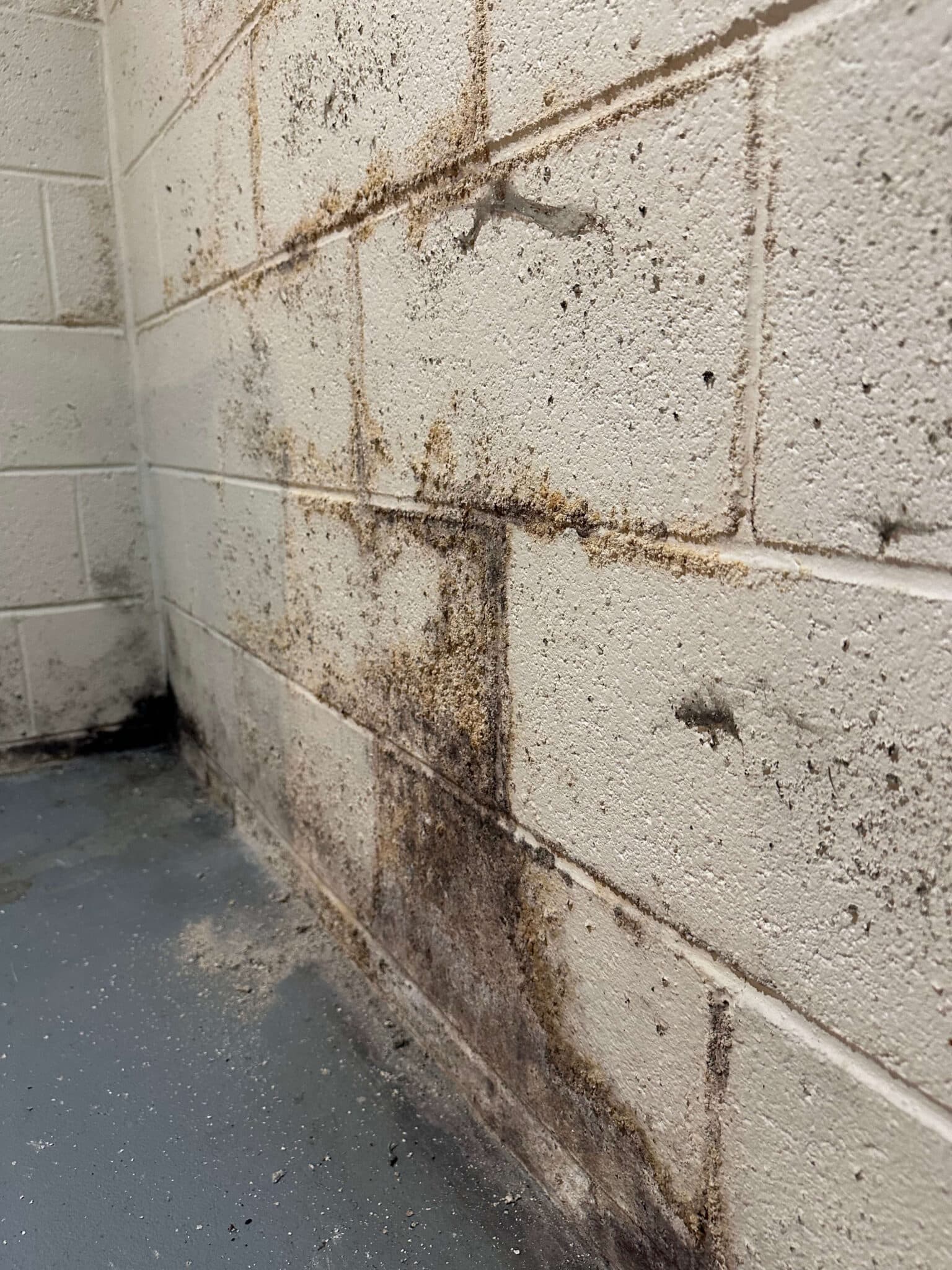
Look closely at color and texture before any test fluid. Efflorescence is white only and crystalline. Mold can be white but is fuzzy or slimy — and often shows green, gray, or black mixed into the same patch. Pure white plus crystalline structure points to salts, not biology.
Test 3 — The Location Pattern Test
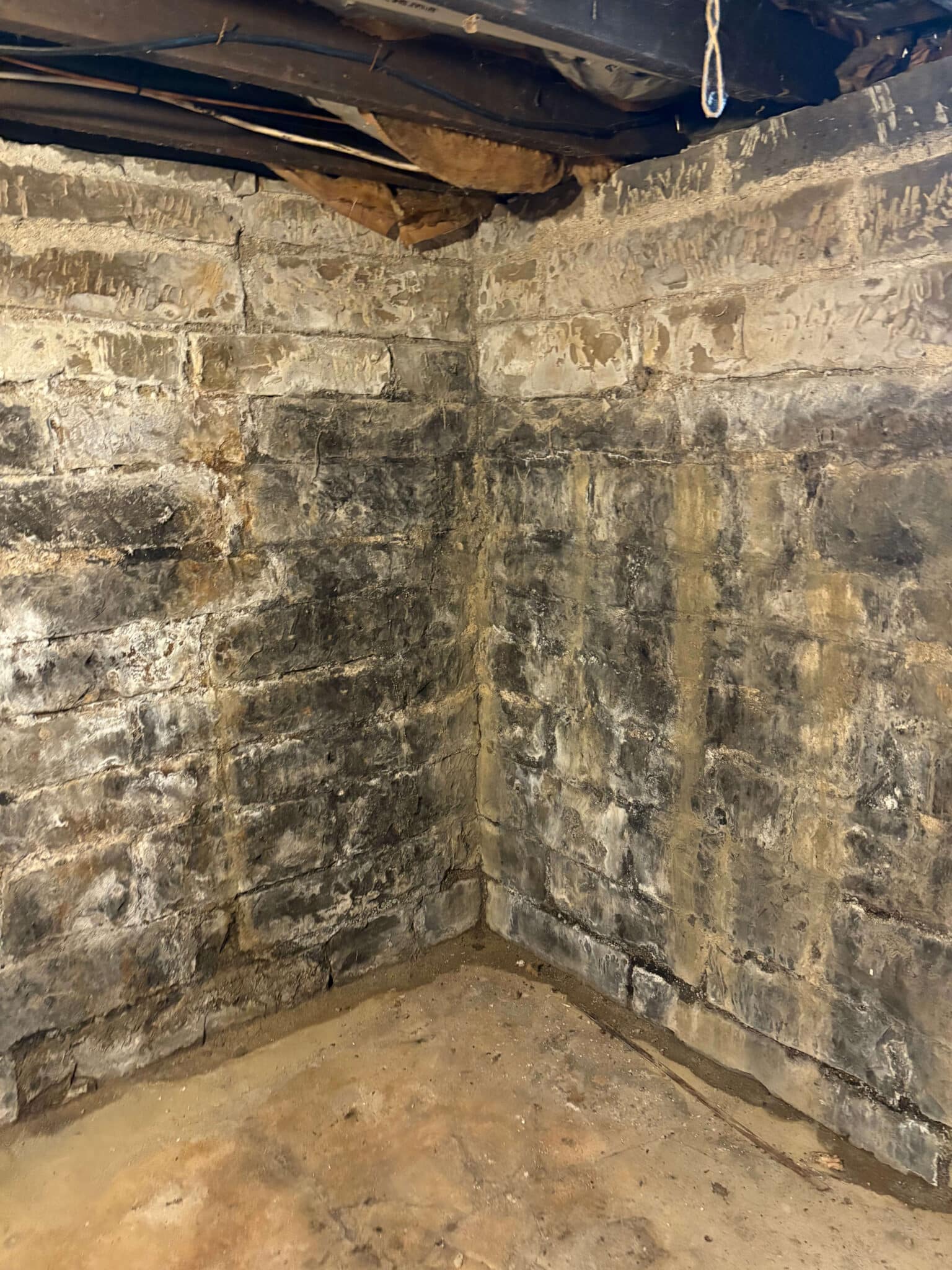
Where on the wall does the deposit show up? Efflorescence concentrates at moisture exit points — mortar joints, cracks, hairline fractures, the bottom course where water wicks up from the slab. Mold colonizes flat surfaces where organic dust collects: face brick, painted brick, sooted areas above a fireplace.
One more confirmatory test if you're still unsure: dab the deposit with dilute household bleach (1:10 in water). Mold pigment lightens within a couple of minutes — the bleach attacks the melanin in fungal cell walls. Mineral salts do not change. Don't soak the wall — chlorine bleach degrades older lime-based mortar.
What Mold on Brick Actually Looks Like — Color & Pattern Guide
Once you've ruled out efflorescence, the color and pattern of the mold tells you what genus you're likely dealing with and how serious it is. No homeowner ID is species-confirmation — that requires lab work — but the color guide below covers what we see across Columbus.
- Black mold on brick. Most often Cladosporium or Aspergillus niger — very common, typically on chronically damp masonry. Less common: Stachybotrys chartarum, which prefers cellulose (drywall, paper) and is rarer on bare brick. Black smears on porous masonry.
- Green mold on brick. Usually Cladosporium, Aspergillus, or Penicillium. Common on shaded north-facing exterior brick, garden walls, and brick at grade where splashback keeps the surface moist.
- White or gray mold on brick. Often Aspergillus or Penicillium in early-stage colonization, or surface yeast colonies. The classic confusion case with efflorescence — run the water test first.
- Pink, orange, or red staining. More commonly bacteria or yeast than mold, sometimes Aureobasidium. Common in brick showers and around plumbing penetrations through masonry.
Pattern Clues by Shape
Spreading patches with irregular edges are characteristic fungal growth — the colony expands outward from a starting point. Linear stains following mortar joints point at moisture migration through the joint and often signal efflorescence or wicking, not surface mold. Polka-dot or speckled patterns across the brick face often mean spore deposition with active colonization.
Is Black Mold on Brick Dangerous?
Honest answer: mold on brick is primarily a property-condition and moisture-signal issue, not a primary health emergency at typical residential exposures. The EPA notes any indoor mold should be addressed; if the affected area exceeds about 10 square feet, professional remediation is appropriate per black mold removal guidance.
Not sure what color or pattern you're looking at? Send a clear photo to 614-810-0000. We'll give the call from the image, free, before any quote conversation.
Why Mold Grows on Brick at All (Brick Doesn't Feed Mold — What's On It Does)
Brick itself is inorganic — fired clay and silica. Mold cannot eat it. What mold eats on a brick wall is everything that has settled onto the surface or migrated into the pores: organic dust, paint binders, mortar additives, soot, dead insects, plant debris, and moisture. The brick is the substrate, not the food.
The Three Conditions Mold Needs on Brick
Mold needs three things: a food source (organic deposits on the surface), free moisture, and a temperature range between 40°F and 100°F. Columbus basements hit all three from May through October without effort. Add the porosity of older brick — pre-1940 stock holds moisture far longer than modern brick — and you have a long-running petri dish.

Why Older Columbus Brick Is Different
Pre-1940 brick in German Village, Italian Village, and Old Town East was fired softer and laid in lime mortar. Lime mortar is vapor-permeable by design — it lets the wall breathe. That same permeability lets bulk moisture move through the assembly when grade, drainage, or downspouts have failed. More moisture in the wall, more food for fungi on the face.
Can Mold Spread From Brick to Drywall?
Yes — and that's where it gets expensive. When brick is furred-out and finished with drywall on the interior, mold on the brick face can migrate to the paper backing and gypsum core of the drywall, which is cellulose-rich and far more hospitable than brick. See our basement mold remediation scope for that pivot.
For mold on adjacent substrates, see our companion guides on mold on drywall and mold on wood. For the broader mildew vs. mold framing, see mold vs. mildew.
DIY vs. Professional — When Brick Mold Cleans Up Easy and When It Doesn't
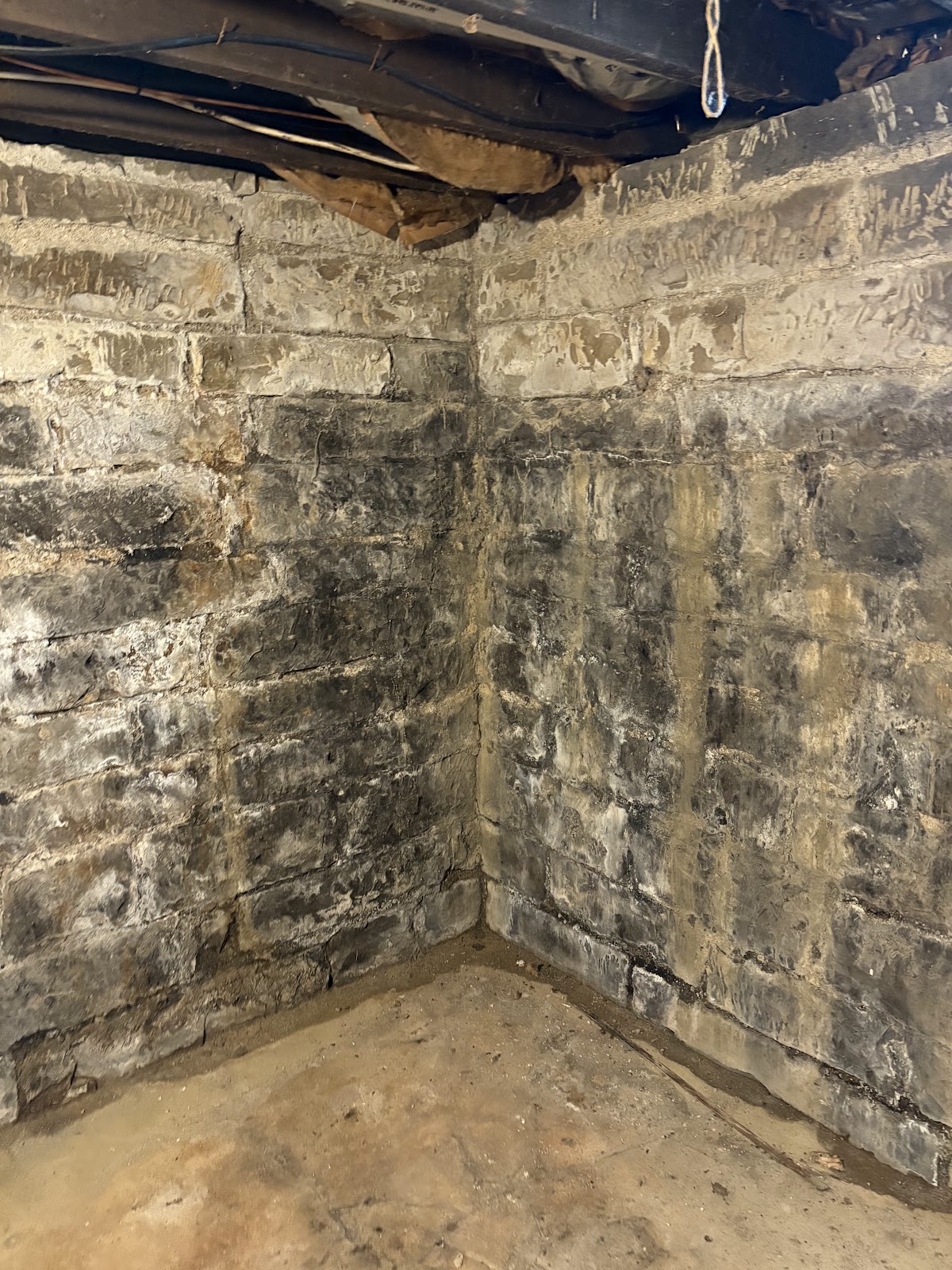
Surface mold on a small, sealed brick area — under about 10 square feet, no recurring moisture, no foundation involvement — is a homeowner job. Anything past that crosses the EPA's residential DIY ceiling and the IICRC S520 professional threshold. Honest answer on where the line is.
The DIY Method for Small Surface Mold
-
Step 1 — Confirm It Is Mold and Confirm Area
Run the three tests above. Confirm the affected area is under 10 square feet, on a single surface, with no signs of recurring moisture. Past that, this is not a DIY scope.
-
Step 2 — Protect Yourself
N95 respirator, nitrile gloves, eye protection. Open a window or run an exhaust fan to outside. Keep kids and pets out of the work area. Cover anything porous nearby with plastic.
-
Step 3 — Pre-Clean and Treat
Brush dry debris with a stiff bristle brush (HEPA-vac afterward, not before). Spray with distilled white vinegar or oxygen bleach (sodium percarbonate). Dwell 30 minutes. Scrub with the brush. Rinse with clean water and dry the surface fully.
-
Step 4 — Monitor for 30 Days
Watch the area for return growth. If anything reappears within 30 to 60 days, the moisture source is still active. That's a professional scope, not a re-clean.
When to Call a Professional
Call iDry — or any qualified IICRC S520 remediator — when any of the following apply. Affected area exceeds 10 square feet. Recurring growth after a previous DIY clean. Basement, crawl space, or below-grade location. Visible water damage to adjacent drywall, framing, or insulation. Musty odor without visible source. Health-sensitive occupants in the home.
Pro scope under Columbus mold remediation includes containment with negative-air HEPA filtration, source removal under sealed conditions, antimicrobial treatment, and post-remediation verification. Past the DIY ceiling, this is the appropriate path. For prevention-focused homeowners, see our mold prevention tips.
Cost of Brick Mold Remediation in Columbus
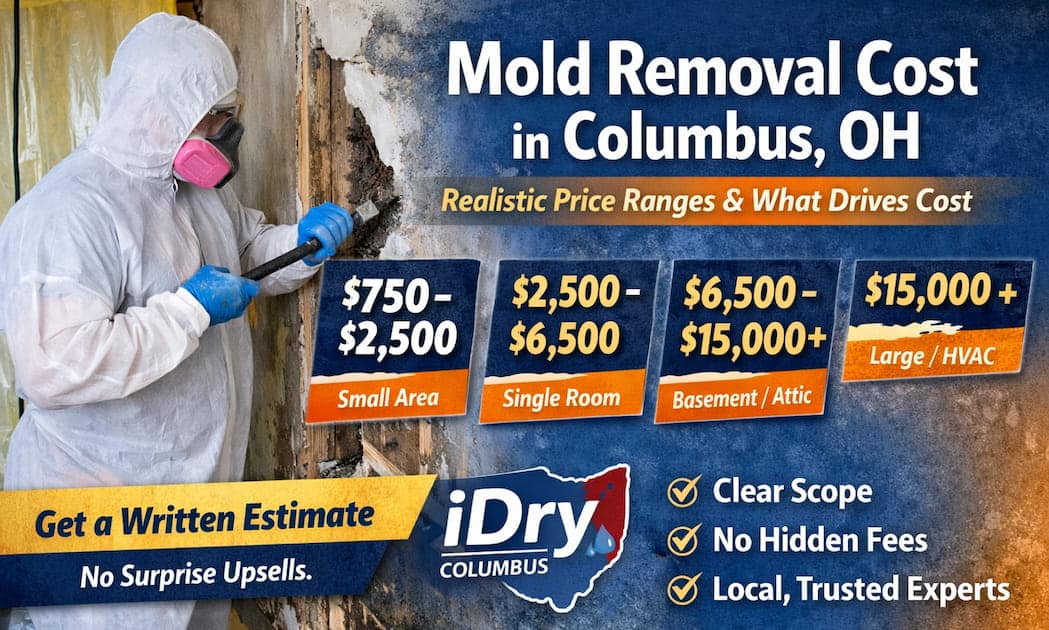
Brick and masonry mold scopes in Columbus span from a low-band single-wall surface clean to multi-thousand-dollar foundation-moisture remediation projects. Affected square footage, recurrence, and whether the underlying moisture source needs fixing drive most of the cost band.
Five typical scope bands from real iDry Columbus brick mold callouts:
Surface Clean — Single Wall
Low Band
Surface mold on a single brick or block wall under 10 sq ft, with no foundation moisture involvement. HEPA vacuum, antimicrobial treatment, surface remediation under containment. Single visit.
Basement Wall Section
Low-to-Mid Band
Mold on a section of a finished or unfinished Columbus basement brick or block wall, 10 to 50 sq ft, surface scope only. Containment, source removal, antimicrobial, verification. No source repair included.
Full Basement / Crawl Space
Mid Band
Widespread brick or block mold across an entire basement wall or a crawl space — common in older Bexley, Clintonville, and German Village stock. Includes drying, containment, antimicrobial, and HEPA air scrubbing.
Veneer Drainage Plane Failure
Mid-to-High Band
Modern Dublin or New Albany brick veneer with mold behind the wall. Brick removal, sheathing replacement, drainage plane repair, weep hole correction, antimicrobial. Coordinated with masonry trades.
Foundation Moisture + Mold
High Band
Recurring mold tied to foundation moisture intrusion. Combined remediation plus exterior grading, downspout, and waterproofing referral coordination. Multi-trade scope. Inspection-led.
Inspection / ID Only
Low Band
Moisture inspection with thermal imaging and meter mapping — the right call when the homeowner wants confirmation before scoping any remediation. Often paired with the mold inspection service.
For the full mold cost framework, see our Columbus mold remediation cost guide. Foundation-moisture-driven scope often pivots to water damage restoration upstream, or to the combined water damage and mold workflow when both are present.
Want a Columbus number for your situation? Send a photo to 614-810-0000 and we'll give you a banded estimate over the phone after the visual ID call.
Insurance Coverage for Brick & Masonry Mold
Brick and masonry mold is rarely a primary covered claim under standard Ohio homeowners insurance. Most carriers treat mold as either excluded or sub-limited unless it follows a sudden, accidental, covered water event — in which case the mold gets bundled into the broader water damage scope.
Limited applicability is the honest framing here. Long-term foundation moisture and gradual seepage — the most common driver of recurring brick mold — are explicitly excluded by every major Ohio carrier. Knowing the vocabulary still matters when a covered event does pull mold into the scope.
When Brick Mold May Be Covered
- Sudden water event upstream. Burst pipe, water heater rupture, or appliance overflow that wets a brick or block wall. Mold that grows from that single event is typically rolled into the water damage scope.
- Sewage backup with rider. If a covered sewage backflow contaminates basement masonry, the contamination scope can include surface remediation. Requires the sewage backup endorsement.
- Storm damage with NFIP coverage. External flood that drives water into brick wythes or masonry foundations may engage NFIP for the broader flood scope, with limited mold sub-limit.
Claim Vocabulary for the Limited Cases When It Applies
- Mold sub-limit. Standard Ohio homeowners policies cap mold remediation at $5,000 to $10,000 even when the underlying water event is covered. Worth knowing before the scope is written.
- Cause of loss. Adjusters require a sudden, accidental cause of loss — not gradual seepage. The brick mold itself isn't the trigger; the upstream water event is.
- Scope of loss. Written line items the adjuster recognizes for payment — demolition, containment, antimicrobial, equipment days, materials, labor.
- ACV vs. RCV. Actual Cash Value pays replacement cost minus depreciation. Replacement Cost Value pays today's cost. Older masonry depreciates heavily under ACV.
- Maintenance exclusion. Failed grade, clogged downspouts, and unaddressed foundation moisture fall under maintenance — not insurance. The most common brick mold driver in Columbus.
- Mold remediation insurance pivot. See our dedicated mold remediation insurance guide for carrier-by-carrier detail.
Brick mold tied to a sudden covered water event? Call 614-810-0000 — we deliver scope of loss in IICRC S500 / S520 format Columbus adjusters expect.
Brick Mold Across Columbus Neighborhoods
The same brick mold scope lands very differently depending on the housing era and the masonry assembly. Three neighborhood patterns drive the bulk of iDry's brick and masonry callouts across Franklin County.
Older Brick Basements — Bexley, Clintonville, Upper Arlington, German Village
Bexley, Clintonville, Upper Arlington, German Village, Italian Village, and Old Town East carry pre-1940 brick foundations with lime mortar joints. The pattern: classic efflorescence-vs-mold confusion on basement walls. Soft, porous brick. Lime mortar joint failure. High permeability lets bulk moisture move through, depositing salts and feeding any organic dust on the face.
Common scopes here include moisture mapping with a meter, distinguishing surface salts from biological growth, and structural assessment of joint condition. Tuckpointing or repointing referrals are common when the mortar has failed. Original foundation waterproofing is often non-existent or has aged out.
Suburban Concrete Block — Worthington, Reynoldsburg, Hilliard, Pickerington
Worthington, Reynoldsburg, Hilliard, Pickerington, Gahanna, and Grove City carry 1970s-2000s concrete block foundations. The pattern: finished-vs-unfinished mold contrast. Sump-pump-driven moisture cycles. Block walls hold less moisture than older brick but show mold faster on the painted face when the dehumidifier dies or the sump fails.
Scope often includes finished basement drywall removal at the bottom plate where mold has migrated from the block face to the cellulose-rich gypsum. See our crawl space mold remediation page for the unfinished crawl variant common in this stock.
Modern Brick Veneer & Masonry — Dublin, New Albany, Powell, Westerville
Dublin, New Albany, Powell, and newer Westerville construction carry post-2000 brick veneer over wood-framed walls. The pattern: drainage plane failures behind the veneer. Weep-hole blockages. Water collecting between the brick face and the sheathing with nowhere to drain — mold blooms out of sight on the back of the brick and on the sheathing.
This scope often requires brick removal in a section, sheathing replacement, drainage plane repair, and weep hole correction. Coordinated with masonry trades. For the broader storm-driven moisture intrusion variant, see Columbus storm water damage restoration.
iDry's Process — How We Approach a Brick Mold Callout
Every Columbus brick mold callout walks the same five-step path. Built on IICRC S520 for the mold scope and S500 for any upstream water source. The steps below are what actually happens on site — not a marketing pitch.
-
Step 1 — On-Site ID and Moisture Mapping
Visual ID against the three-test framework. Penetrating moisture meter readings on the brick or block wall, adjacent drywall, and bottom plate. Thermal imaging where elevation suggests interior moisture. The mold-vs-efflorescence call is made and confirmed before any scope discussion.
-
Step 2 — Source Diagnosis
Where is the moisture coming from? Exterior grade walk. Downspout and gutter check. Crawl space or basement assessment. Plumbing penetrations through masonry inspected. The source determines whether the wall scope is a one-time clean or paired with foundation work.
-
Step 3 — Containment and Remediation
Negative-air HEPA filtration containment for any scope past the EPA 10 sq ft DIY ceiling. Source removal under sealed conditions per IICRC S520. HEPA vacuuming. Antimicrobial treatment compatible with porous masonry — no chlorine bleach on lime mortar.
-
Step 4 — Drying and Verification
Active drying with LGR dehumidifier and air movers if moisture readings are above the substrate baseline. Daily monitoring until the wall returns to baseline. Visual inspection plus moisture verification before containment comes down.
-
Step 5 — Source Coordination and Handoff
Where the moisture source needs trade coordination — foundation, masonry, drainage — we hand off with a written scope and a referral. Final IICRC S520 documentation for the homeowner and any future buyer's inspection record.

Two field rules from the iDry crew. Confirm the ID before any scrubbing. Half the calls we run on "mold" turn out to be efflorescence — and scrubbing salts with bleach makes the next round worse. Treat recurrence as a moisture problem, not a cleaning problem. If it's coming back, the wall isn't the issue.

What Columbus Homeowners Say About iDry
-
Kendra Turner ★★★★★
iDry Columbus went above and beyond for my family when we had a water emergency. They responded quickly, communicated clearly through the whole process, and left our home in great shape. Curtis and the team treated us like family — not just another job.
-
David Warner ★★★★★
The way Curtis and his crew handled our situation was old school in the best way — honest, respectful, and thorough. They cleaned out years of buildup without judgment and left the property ready for renovation. Communication was clear from start to finish.
-
Stacy Connelly ★★★★★
We had a mold problem in our basement that two other companies failed to fix properly. iDry came in, identified the source of moisture, and remediated everything correctly. The musty smell is completely gone and the basement is dry. Professional, on time, and fair pricing.
Related Mold Remediation Resources
Brick mold rarely lives alone — it almost always pairs with a basement moisture, drywall, or inspection scope. Use these companion guides for the broader mold silo — or call 614-810-0000 for direct help now.
-
Pillar
Mold Remediation
Cluster pillar covering every mold scope across Columbus — the broader silo overview this page belongs to.
-
Sibling
Mold Inspection
Moisture mapping, thermal imaging, and source diagnosis — the right call when brick mold keeps coming back.
-
Sibling
Basement Mold Remediation
Where most brick and block mold lives — the basement-specific scope and process.
-
Sibling
Crawl Space Mold Remediation
Crawl space block walls and pier foundations — common in older Columbus housing stock.
-
Color Sibling
Black Mold Removal
Black mold specifically — the color-modifier scope for visitors searching the toxic-mold framing.
-
Cost
Mold Remediation Cost
Full cost framework across every mold scope — the long-form pricing reference behind the bands above.



Common Questions — Mold on Brick & Masonry
Real questions Columbus homeowners ask when they spot a deposit on a brick or block wall. Answered directly — no filler.
How do I tell efflorescence from mold on a brick wall?
Spray the deposit with water. Efflorescence — mineral salts — dissolves and washes away. Mold does not. Efflorescence is also crystalline and gritty; mold is fuzzy or slimy. On Columbus basement walls, the water test settles the call inside 30 seconds.
Will vinegar kill mold on brick?
Distilled white vinegar kills surface mold on brick by lowering the pH below what fungi tolerate. Spray, dwell 30 minutes, scrub, rinse. Works on light, recent growth on small areas. Won't penetrate deep into porous Columbus masonry, and doesn't address the moisture source feeding it.
What kills mold on bricks?
For light surface mold on Columbus brick, distilled white vinegar or oxygen bleach (sodium percarbonate) both work without damaging mortar. Avoid chlorine bleach on porous masonry — it weakens lime mortar common in pre-1940 stock. Past 10 sq ft, professional remediation under IICRC S520 is the right call.
Is mold on brick dangerous?
Mold on brick is mainly a property-condition and moisture-signal issue. It indicates the wall stays wet long enough to support fungi, which over time degrades mortar and adjacent finishes. EPA recommends addressing any indoor mold; consult a Columbus professional if the area exceeds about 10 square feet.
Can mold grow on brick?
Yes — honestly easier than most homeowners think. Brick itself is inorganic, but mold feeds on the organic dust, paint, and mortar additives sitting on the surface. With moisture in the wall, Columbus basements grow mold on brick year-round — especially in older Bexley and German Village stock.
Why does my Columbus basement brick keep getting moldy?
Recurring mold below grade is almost always a moisture-source problem, not a wall-cleaning problem. In older Columbus neighborhoods — German Village, Italian Village, Clintonville — pre-1940 foundations were not built to modern drainage standards. Bulk water enters from grade and footer drains. Source repair, not re-cleaning, ends the cycle.
Does Dawn dish soap kill black mold on brick?
Dawn doesn't kill mold — it's a surfactant. It lifts surface debris so a fungicide can reach the substrate. Use it as a pre-clean before vinegar or oxygen bleach on Columbus brick, not as a standalone treatment. For black mold beyond a small spot, professional assessment is the prudent path.
Will pressure washing remove mold from brick?
Pressure washing removes surface mold but commonly drives moisture deeper into porous Columbus brick and damages mortar joints — both set up the next round of growth. Use the lowest effective pressure, a fungicide pre-treatment, and follow with a vapor-permeable masonry sealer once the wall is fully dry.
Should I seal Columbus brick after removing mold?
A vapor-permeable (breathable) masonry sealer is appropriate after the wall is fully dry and the moisture source is addressed. Avoid film-forming sealers on older Columbus brick — they trap moisture and accelerate spalling. On lime-mortar buildings in German Village and Italian Village, specify the sealer with a masonry pro.
Is mold on a chimney brick a real problem?
What I tell folks is yes — especially on shaded north-facing chimneys across Columbus. Mold on chimney brick signals that the crown, flashing, or cap is letting water sit in the masonry. Surface clean is straightforward; the actual fix is upstream. Pair with a chimney inspection before you pay for cleaning.
Get a Brick Mold Assessment
Tell us where the deposit is, what color and texture it shows, and how long it's been there. We'll call back inside the day to schedule a Columbus inspection, walk the mold-vs-efflorescence call with you, document scope of work to IICRC S520 standards, and give you a written estimate. For immediate help, call 614-810-0000.
Brick & Masonry Mold Service Area — Columbus and Suburbs
Brick mold inspection near me — iDry runs across Columbus and the surrounding Franklin County suburbs. 30+ years across every Columbus neighborhood. Tap your area below to jump to the housing-era pattern that drives most brick mold scopes there.
Also serving: Lewis Center, Delaware, Johnstown, Whitehall, Canal Winchester, Pataskala, Sunbury, Marysville, Lancaster — all of Franklin County and surrounding Central Ohio communities.