
By Curtis Teets, owner and operator, iDry Columbus · Last reviewed .
Mold on Wood in Columbus, OH: Identify, Decide, Remediate
Spotted mold on a hardwood floor, basement joist, attic rafter, or piece of wood furniture? The right move depends on the substrate, the color, and how deep the growth has rooted. This guide walks the substrate-by-substrate decision — clean it, sand it, or call a Columbus pro who works to IICRC S520 standards.

Real Columbus mold-on-wood guidance from Curtis Teets, owner and operator of iDry Columbus — 30+ years across Bexley, Dublin, Westerville, Hilliard, Upper Arlington, Worthington, Gahanna, and surrounding Franklin County. All work performed to IICRC S500 (water damage) and S520 (mold remediation) industry standards. Call 614-810-0000.
The Substrate Question — Why Mold on Wood Is Not One Problem
Mold on hardwood flooring, framing lumber, OSB subfloor, MDF furniture, and painted wood paneling are five different remediation problems. Most homeowner guides treat them as one. They are not. The substrate decides whether you can clean it, sand it, treat it, or have to cut it out under containment per IICRC S520.
What changes between substrates: how deep the hyphae root, whether the surface is sealed against penetration, whether the wood is structural, and whether the assembly carries hidden moisture below the visible growth. Get the substrate wrong and you spend money on the wrong fix.

Substrate 1 — Hardwood Floors (Oak, Maple, Engineered)
Sealed top, raw bottom. Polyurethane or wax resists colonization on the show face. The unfinished underside takes water from below — subfloor moisture, vapor migration, dishwasher leaks — and grows unseen until the board cups, blackens, or smells musty. Most Columbus hardwood mold is bottom-up.
Substrate 2 — Framing Lumber (Studs, Joists, Rafters)
Raw on every face. Pine, fir, and SPF dimensional lumber inside walls and crawl spaces have nothing protecting them. White, black, or green colonization appears within weeks of sustained 20%+ wood moisture. Structural framing crosses the IICRC S520 professional line.
Substrate 3 — Furniture (Porous vs. Sealed)
Two paths. A solid oak or maple table with a sealed finish gets surface-cleaned and is usually saved. MDF, particleboard, or unfinished pine furniture absorbs spores into the fiber. The DIY repair fails. Discard porous furniture once colonization is visible.
Substrate 4 — Subfloors (OSB and Plywood)
Engineered wood under your feet. Glues hold the layers together. Sustained moisture delaminates the panel, and mold colonizes the open fiber face. Once an OSB subfloor delaminates with mold present, the panel comes out — sanding does not restore structural rating.
Substrate 5 — Painted or Sealed Wood Paneling
Cosmetic surface, sealed face. Paint and varnish slow penetration but do not stop it. Mold often appears at seams, edges, and where paint has aged or been scratched. Surface clean and reseal works for small areas; widespread blooms point to wall-cavity moisture behind the panel.
The information-gain rule from 30 years of Columbus callouts: treat the substrate, not the symptom. Wipe-down works on a sealed maple cutting board; it is the wrong call for OSB subfloor. Demo-and-replace on a $40 piece of furniture is also wrong. See our Columbus mold prevention tips to keep wood out of mold-supportive territory.
Visual ID — What Color Mold on Wood Actually Means
Color narrows the species range, but it does not confirm a species or set toxicity. White, black, green, and yellow are the four patterns Columbus homeowners ask about most. Visual ID alone never beats lab testing — what color tells you is what to expect for substrate behavior and what action threshold applies.
Below: the four most common color patterns on wood across Columbus homes, with the species typically responsible and the substrate they tend to colonize first.

White Mold on Wood
Powdery, fuzzy, or cottony white growth. Often Penicillium, Aspergillus, or early-stage Trichoderma. Common on framing lumber, joists, and crawl-space subfloors in Columbus homes with high basement humidity. Not automatically less dangerous than black — pulls the same IICRC S520 thresholds when the surface area or substrate type qualifies.
Black Mold on Wood
Dark green to black, often slimy when wet. Could be Stachybotrys chartarum (the species most people mean by “toxic black mold”) or much more commonly Cladosporium or Aspergillus niger. Visual ID cannot distinguish them. The action rule is the same: surface area and substrate decide the call, not species guesswork.
Green Mold on Wood
Olive, sage, or bright green patches. Often Cladosporium, Aspergillus, or late-stage Trichoderma. Common on furniture stored in Columbus basements through humid summers, and on crawl-space joists with chronic moisture. Surface clean for small furniture; structural framing crosses to IICRC S520.
Yellow Mold on Wood
Yellow to orange-brown discoloration. Often Serpula lacrymans (true dry rot) or Aspergillus flavus on wet wood. Yellow on wood is a structural warning — Serpula consumes wood fiber from the inside. A yellow patch on framing or subfloor in Columbus warrants a probe test for soft fiber before any cosmetic decision.
What Can Be Mistaken for Black Mold on Wood
Three patterns get called “black mold” on Columbus wood and are not. Iron tannin staining (water plus iron in the wood) wipes with oxalic acid. Soot from a furnace puff-back smudges with a damp cloth. Aureobasidium pullulans, a black-yeast skin on outdoor wood, brushes off and does not penetrate.
None of these three need IICRC S520 remediation. The visible-and-spreading test still applies though — if it grows back, treat it as mold and re-test.
Mildew vs. Mold on Wood — The 60-Second Test
Mildew on wood sits on the surface, powdery and gray-to-white, and wipes away. Mold has rooted into the grain — fuzzy, slimy, or velvety, often green, black, white, or yellow, and it comes back after surface cleaning.
The 60-second test: dab the spot with a cotton swab dipped in 1:10 diluted bleach. Lightens immediately and stays gone is mildew. Stays dark or returns in days is mold. See our mold vs. mildew guide for long form.
Save vs. Replace — When Wood Comes Out
Most non-structural wood with surface-only mold can be saved — clean, sand, treat, seal. Wood with deep colonization, structural involvement, or porous-fiber damage gets cut out and replaced. The decision rests on three thresholds drawn from IICRC S520 and EPA mold guidance, not on how the panel looks.
-
Threshold 1 — Affected Area Over 10 Square Feet
Both IICRC S520 and the EPA flag 10 square feet as the professional line. Below that area, a careful homeowner can handle a small surface bloom on furniture or paneling. Above it, containment, HEPA filtration, and PPE are the standard — not optional. Surface area means the contiguous mold-affected wood, not just the visible patch.
-
Threshold 2 — Structural Wood Involvement
Any framing lumber, joist, rafter, sill plate, beam, or load-bearing member with mold is a professional scope, regardless of square footage. A 2-square-foot black mold patch on a Bexley basement joist still triggers IICRC S520. The risk is not the area — it is the structural role and the moisture source feeding it.
-
Threshold 3 — Repeat Occurrence in 12 Months
Mold returning to the same wood in the same location within 12 months means the moisture source was never resolved. Surface cleaning the second bloom does nothing. The scope expands to include moisture-source diagnosis — vapor barrier, sump, plumbing, roof, ventilation — before the next remediation.
One quick sanity check from the field: if a flathead screwdriver pushes into the wood with light pressure, the fiber is gone. Sanding does not restore it. The board is structurally compromised — that wood comes out.
See our Columbus black mold removal guide for full workflow detail when the structural threshold is hit on a Columbus job.
What Kills Mold on Wood (and What Does Not)
Four DIY-feasible treatments work on porous wood. One that everyone reaches for — bleach — does not. The sorting rule is simple: porous substrates need a treatment that penetrates fiber. Surface-only sanitizers leave the hyphae alive in the grain.

1. Hydrogen Peroxide (3% to 10%)
Drugstore 3% hydrogen peroxide is the homeowner workhorse for surface mold on sealed wood. Saturate the spot, let it sit 10 minutes, scrub with a stiff brush, wipe dry. Oxidizes cell walls and bleaches the visible stain. Step up to 10% from a hardware store for stubborn cases.
2. Distilled White Vinegar
Plain undiluted distilled white vinegar (5% acetic acid) penetrates lightly and works on small surface colonies. Spray on, let stand an hour, scrub, dry thoroughly. Works on mildew and small mold spots. Loses to peroxide on heavier colonization. Best DIY tool for cutting boards, butcher block, and food-contact furniture because the residue is food-safe.
3. Borate (Sodium Borate) Treatments
Borate-based wood treatments — sold under brand names like Bora-Care or Tim-Bor — penetrate fiber and leave residual protection. The cellulose absorbs the borate, killing existing colonies and preventing reinfection for years. The pro choice for raw framing lumber, joists, and rafters when the wood stays. Apply per label, allow to penetrate, follow with antimicrobial encapsulant for long-term seal.
4. HEPA Vacuum and Sand
For visible spore loads on raw wood, HEPA-vacuum the surface first, then sand to clean wood, then HEPA-vacuum again. Removes spores mechanically before any chemical hits the substrate. Combined with peroxide or borate as the killing step. This is the IICRC S520 surface-prep workflow we run on every Columbus framing job that stays in place.
Why Bleach Fails on Porous Wood (the Myth-Bust)
Sodium hypochlorite (household bleach) bleaches the visible stain but does not kill the mold inside porous wood. Two reasons: the chlorine ion does not penetrate cellulose, and residual moisture from the bleach feeds the next bloom.
Bleach belongs on tile, glass, and grout. On Columbus framing, subfloor, or hardwood, it is the most common DIY mistake we re-treat on callbacks.
What Kills Mold on Wood Permanently
Permanent removal requires three things, not one chemical: kill the colony, fix the moisture source, and seal the wood against reinfection. Borate plus antimicrobial encapsulant handles kill and seal. The moisture fix decides whether you call us back in 12 months.
Columbus Humidity, Old Houses, and Wood Mold Patterns
Central Ohio summer dew points routinely cross 70°F from June through August, and finished basements without dehumidification regularly hold 65 to 75% relative humidity. Wood needs moisture content under 16% to resist colonization. Above 20%, mold on framing and subfloor is weeks away, not months.

Three Columbus housing eras carry distinct wood mold patterns:
- Pre-WWII stock — Bexley, Clintonville, German Village, Upper Arlington. Original-growth oak floors, pine framing, plaster-lath cavities, and below-grade construction without modern vapor management. Wood moisture spikes through the basement during humid stretches. Common pattern: white or green mold on the underside of original oak floors and on basement joists.
- 1970s-2000s finished basements — Worthington, Reynoldsburg, Hilliard, Pickerington. Sump-pump-dependent assemblies. Crawl spaces with chronic moisture and exposed subfloor underside. Common pattern: mold on OSB subfloor from below, on floor joists in the crawl, and at the bottom plate of finished basement walls.
- Post-2010 builds — Dublin, New Albany, Powell, newer Westerville. Engineered framing (LVL, glulam beams), OSB sheathing, modern vapor barriers, but tighter envelopes that trap attic moisture. Common pattern: mold on attic rafters and roof sheathing from inadequate ventilation rather than basement humidity.
The local rule: chase the moisture source by housing era before scoping the mold. A 1925 Bexley basement and a 2018 Dublin attic with the same visible mold call for different fixes. For the deeper local pattern, see our Columbus neighborhood mold risk index.
Central Ohio summer dew points (June through August). Finished basements without dehumidification routinely sit at 65 to 75% relative humidity — the moisture envelope where mold on wood becomes a matter of weeks, not seasons.
Wood Mold by Location — Floors, Framing, Furniture, Subfloors, Paneling
The substrate framework above sets the rules. The location is where those rules meet a real Columbus job. Below: how mold on each substrate actually looks across a Columbus basement, crawl space, attic, kitchen, and living room — and what the typical scope of work runs.
Mold on Hardwood Floors (Oak, Maple, Engineered)
Most Columbus hardwood mold on wood floor surfaces grows from below, not above. A dishwasher leak, a slow refrigerator line, or vapor from a humid basement wets the unfinished underside. Mold colonizes the bottom face. The top cups, blackens at seams, or grows musty.
Sand-and-refinish handles cosmetic top-side stains. Bottom-up colonization on Bexley original oak or modern engineered planks usually means board removal, subfloor remediation, and reinstall.
Mold on Framing Lumber (Studs, Joists, Rafters)
Pine, fir, and SPF framing on basement walls, crawl-space joists, attic rafters, and wall cavities is the highest-risk wood substrate in Columbus homes. Raw on every face, structural by definition, fed by hidden moisture. Any visible colonization here crosses the IICRC S520 line regardless of square footage.
Scope: containment, HEPA filtration, source removal where colonization is established, borate plus antimicrobial encapsulant where the wood stays.
Mold on Wood Subfloors (OSB and Plywood)
OSB and plywood subfloors fail differently than dimensional lumber. The glue between layers loses bond when sustained moisture penetrates. Once the panel delaminates with mold present, sanding does not restore the structural rating — the panel comes out and gets replaced.
Common Columbus pattern: a refrigerator drip in a Worthington kitchen, or a shower pan failure in a Hilliard upstairs bath. Both surface months later when the floor flexes.

Mold on Wood Furniture — The Porous vs. Sealed Call
Sealed solid-wood furniture — oak, maple, walnut tables, dressers, chairs — saves with surface treatment in most cases. HEPA-vacuum, peroxide or vinegar wash, dry thoroughly, refinish if needed.
Porous fiber furniture is a different decision. MDF nightstands, particleboard bookcases, and unfinished pine pieces absorb spores into the fiber. Discard porous pieces with visible colonization — replacement cost beats a failing remediation attempt.
Mold on Wood Cutting Boards and Food-Contact Surfaces
Wood cutting boards with shallow surface mold can be saved. Scrape with a card scraper or sandpaper to clean wood, treat with vinegar (food-safe residue), dry completely, re-oil with food-grade mineral oil.
If mold has penetrated the seams of a glued butcher-block board or the wood is soft when probed, replace it. Cutting boards are a low-cost replace decision — do not gamble with food contact.
Mold on Painted or Sealed Wood Paneling
Painted or varnished wood paneling carries surface mold at seams, edges, and aged-finish areas. Small patches surface-clean with peroxide and reseal. Widespread or recurring blooms point to wall-cavity moisture behind the paneling — the visible mold is the symptom.
The scope expands to cavity inspection, source diagnosis, and often paneling removal so the substrate behind can be remediated.
Mold on Attic Rafters and Roof Sheathing
Attic mold on rafters and OSB sheathing is the most common single Columbus wood mold scope by callout volume. Drivers: insufficient soffit-to-ridge ventilation, bathroom or dryer exhaust dumping into the attic, ice dam moisture.
The fix is a combined-scope job — remediation under containment plus the ventilation correction. See our Columbus attic mold remediation guide for full workflow.
Mold on framing in a Columbus basement, crawl, or attic? Stop and call 614-810-0000. Structural wood mold is not a DIY scope on any substrate.
Cost to Remove Mold From Wood in Columbus
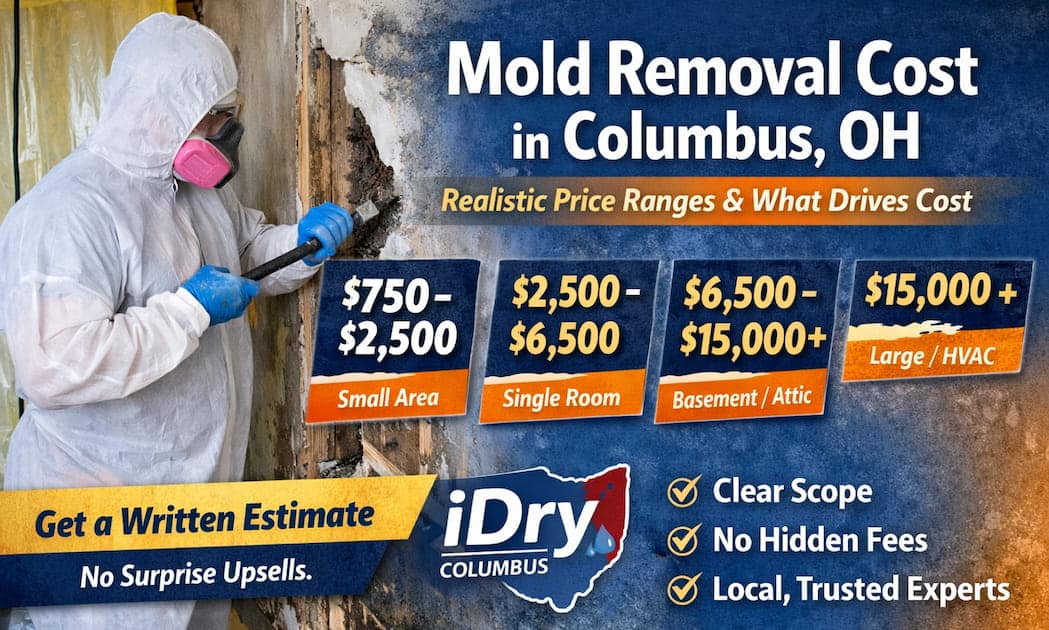
The cost of wood mold remediation in Columbus runs from trivial (a $40 furniture replacement) to substantial (multi-thousand-dollar framing replacement under containment). Substrate, structural role, and area drive the band. We do not publish hardcoded numbers because the variables that move the price are real and material.
Six substrate-banded scope types from real iDry Columbus callouts:
Wood Furniture (Single Piece)
Trivial to Low Band
Sealed solid-wood furniture: surface clean, treat, refinish — usually a DIY job. Porous fiber furniture (MDF, particleboard): replace at retail cost. Almost always below the remediation-call threshold.
Hardwood Floor — Small Affected Area
Mid Band
Cosmetic top-side stain: sand and refinish by a flooring contractor. Bottom-up colonization on a few boards: board removal, underside treatment, board replacement. Mid-band scope.
Hardwood Floor — Widespread + Subfloor
High Band
Multiple boards plus subfloor delamination: full demo, subfloor replacement, IICRC S520 cavity remediation, hardwood reinstall and refinish. High-band, insurance-relevant scope.
Framing Lumber — Localized
Mid-to-High Band
Containment, HEPA filtration, sister-frame or partial replacement, borate treatment, antimicrobial encapsulant, post-remediation verification (PRV). Standard IICRC S520 scope.
Framing Lumber — Widespread
High Band
Major demolition, structural reframing, full IICRC S520 protocol, PRV. Top-of-band, insurance-relevant scope — common after extended Cat 2 / Cat 3 water events.
Wood Subfloor (OSB / Plywood)
Mid-to-High Band
Demo and replace the panel, address the moisture source (vapor barrier, plumbing, sump), reinstall finish flooring on top. Pairs with a framing or hardwood line item on most jobs.
For the full-spectrum cost framework across all mold types, see our Columbus mold remediation cost guide. For attic-specific scope, see attic mold remediation. For crawl-space joist work, see crawl space mold remediation in Columbus.
Want a Columbus-specific number? Send a photo of the wood to 614-810-0000 and we will give you a substrate-banded estimate over the phone.
Insurance Coverage for Wood Mold Damage
Mold on wood from a sudden, accidental water event is typically covered by Ohio homeowners insurance, with a mold sub-limit. Mold from gradual leaks, high humidity, or deferred maintenance is generally excluded. Major Columbus carriers — State Farm, Allstate, Erie, Nationwide, USAA, and Liberty Mutual — all use the sudden-vs-gradual cause of loss distinction.
The adjuster examines four things on a wood-mold claim: cause of loss (sudden vs. gradual), date of event, scope of loss documentation, and any IICRC standards reference in the contractor scope.
The scope of loss iDry delivers carries claim number, IICRC reference, schedule of loss for damaged contents, and substrate-banded line items — the format Columbus adjusters expect.
Ohio Coverage Snapshot — Major Columbus Carriers
- State Farm. Covers sudden/accidental water with mold sub-limit (commonly $5,000 to $10,000 unless endorsed higher). ACV by default in Ohio policy forms; replacement cost value (RCV) with the right endorsement.
- Allstate. Covers sudden/accidental. Mold sub-limit standard. ACV or RCV depending on policy form. Standard deductible $500 to $2,500.
- Erie Insurance. Covers sudden/accidental. Mold sub-limit standard. RCV common in Ohio Erie policies. Strong claim-handling reputation in Central Ohio.
- Nationwide. Covers sudden/accidental. Columbus is Nationwide's home market. Mold sub-limit standard. ACV default; RCV available with rider.
- USAA. Covers sudden/accidental. RCV more common (military families). Subrogation pursued aggressively when a third party caused the loss.
- Liberty Mutual. Covers sudden/accidental. Mold sub-limit standard. ACV default; RCV available with rider.
Claim Number, Deductible, Scope of Loss, Subrogation
The four insurance terms that drive how a Columbus wood-mold claim flows:
- Claim number. Issued by the carrier when you file. iDry references your claim number on every report so the adjuster reconciles the file in one pass.
- Deductible. Standard Ohio deductible runs $500 to $2,500. Applied to the overall claim, not separately to the mold sub-limit. Furniture-only scope often lands below the deductible — sometimes the right move is self-pay.
- Scope of loss. The written list of every line item the adjuster recognizes for payment. Demo, containment, HEPA filtration, treatment, materials, labor, and the schedule of loss for damaged contents. Built to IICRC S500 / S520 format.
- Subrogation. If a third party caused the loss — a contractor's failed plumbing, a manufacturer defect, an upstairs neighbor — your carrier pays your claim, then pursues recovery from the responsible party.
ACV vs. Replacement Cost (RCV) on a Wood Mold Claim
Actual Cash Value (ACV) is replacement cost minus depreciation. Replacement Cost Value (RCV) is what the work actually costs today. The gap matters most on older Columbus stock — original Bexley oak floors or 1940s Clintonville framing have lost most of their depreciable life. Ask the adjuster which form your policy carries before signing the scope of loss.
For the full insurance-claim workflow, see our Columbus mold remediation insurance guide. When the wood mold pairs with a recent water event, route through water damage and mold for the combined scope.
Adjuster wants an IICRC S520 scope? Call 614-810-0000 — we deliver the scope of loss in the format Columbus adjusters expect.
Wood Mold Across Columbus Neighborhoods
The same wood-mold scope lands differently depending on the neighborhood's housing era and assembly type. The patterns below are not zip-code price tables — they are the substrate and moisture realities that decide which scope a typical job in each area falls into.
Hardwood Floors in Older Homes — Bexley, Clintonville, Upper Arlington, German Village
Bexley, Clintonville, Upper Arlington, German Village, and Worthington carry pre-1970 housing stock. Original-growth oak hardwood, pine framing, plaster-lath wall cavities, and below-grade construction without modern vapor management. The wood is older, denser, and often more valuable than modern engineered flooring — but the assembly drives moisture into the substrate during humid Columbus summers.
Two practical effects on the call. First, the bottom-up moisture pattern hits original oak hardest in the basement-perimeter rooms. Second, plaster-lath behind a remodel adds a separate cut-and-patch line once the framing is exposed. Most jobs here land in board removal, framing inspection, and reinstall — rarely a top-side sand alone.
Crawl Space Framing & Subfloors — Worthington, Reynoldsburg, Hilliard, Pickerington
Worthington, Reynoldsburg, Hilliard, Pickerington, Gahanna, and Grove City carry a lot of 1970s through 2000s assemblies with vented crawl spaces. Sump-pump-dependent. Vapor management often dated. Floor joists exposed to chronic crawl-space humidity, OSB subfloor exposed from below, and bottom-plate framing on finished basement walls all riding the moisture curve.
The pattern: chronic crawl humidity colonizes joists and subfloor underside before any acute event. Discovery happens during a real estate inspection or when the floor flexes underfoot.
Scope flows to multi-joist treatment plus the moisture fix — vapor barrier, encapsulation, dehumidification — often paired with a sump or grading review. See our crawl space mold during real estate guide for the inspection workflow.
Attic Rafters & Sheathing — Dublin, New Albany, Powell, Westerville
Dublin, New Albany, Powell, and the newer Westerville build-outs carry post-2010 construction. Engineered framing (LVL beams, OSB sheathing), modern vapor barriers, code-compliant ventilation in spec — but tighter envelopes that trap attic moisture when ventilation falls below spec on a real install.
The pattern: mold appears on roof sheathing and rafter faces from inadequate soffit-to-ridge airflow, bathroom exhaust dumped into the attic instead of out the roof, or ice dam moisture in winter. Scope flows to attic remediation under containment plus the ventilation correction. See our Columbus attic mold remediation guide for full workflow detail.
For city-by-city service area detail, jump to the service area block. For pillar context across the silo, see our Columbus mold remediation overview. Basement-driven wood mold routes through basement mold remediation. Crawl-space-driven scope routes through crawl space mold remediation.
The iDry Process on a Wood Mold Callout
Every Columbus wood-mold callout walks the same five-step path. The path is built on IICRC S520 for the mold scope and IICRC S500 when the mold pairs with an active water event. The steps below are what actually happens on site — not a marketing brochure.
-
Step 1 — On-Site Substrate and Moisture Assessment
Free Columbus assessment, same-day in most cases. Substrate identification (which wood, which structural role), penetrating moisture meter readings, hygrometer readings on cavity humidity, and a probe test for soft fiber. Photos documented before any disturbance — the adjuster needs that record.
-
Step 2 — Decision Tree Against the Three Thresholds
The three thresholds — over 10 sq ft, structural involvement, repeat occurrence — get checked on site. Substrate framework guides the call: hardwood, framing, subfloor, furniture, paneling each get the right treatment path or the right replace scope.
-
Step 3 — Containment and Source Removal (or Surface Treatment)
On the replace path: 6-mil poly containment, negative air with HEPA filtration per IICRC S520, PPE, source removal of colonized wood, sealed disposal. On the save path: HEPA-vacuum, borate or peroxide treatment, mechanical removal where needed, antimicrobial encapsulant.
-
Step 4 — Moisture Source Fix
Vapor barrier, sump pump, plumbing repair, ventilation correction, dehumidification — the part of the job competitors skip. Mold returns to the same wood within 12 months when the source is not resolved. We diagnose and refer the source fix on every callout.
-
Step 5 — Rebuild, Post-Remediation Verification, and Adjuster Handoff
New framing or sister boards where called for, subfloor replacement, finish reinstall. Post-remediation verification (PRV) — visual plus moisture meter readings — releases the rebuild. Final scope of loss in the format Columbus adjusters expect, with claim number and IICRC S520 reference.

Two field rules from the iDry crew. Document before disturbance. Photos and moisture readings before the first cut protect the claim and the homeowner. Verify dry by reading, not by calendar. A board that “feels dry” can still be 22% moisture content under the surface — mold-ready territory for any porous wood.

What Columbus Homeowners Say About iDry
-
Kendra Turner ★★★★★
iDry Columbus went above and beyond for my family when we had a water emergency. They responded quickly, communicated clearly through the whole process, and left our home in great shape. Curtis and the team treated us like family — not just another job.
-
David Warner ★★★★★
The way Curtis and his crew handled our situation was old school in the best way — honest, respectful, and thorough. They cleaned out years of buildup without judgment and left the property ready for renovation. Communication was clear from start to finish.
-
Stacy Connelly ★★★★★
We had a mold problem in our basement that two other companies failed to fix properly. iDry came in, identified the source of moisture, and remediated everything correctly. The musty smell is completely gone and the basement is dry. Professional, on time, and fair pricing.
Related Mold and Substrate Resources
Mold on wood rarely lives alone. Use these companion guides for adjacent substrates, locations, and insurance coordination — or call 614-810-0000 for direct help now.
-
Pillar
Columbus Mold Remediation
The full residential and commercial overview — assessment, containment, source removal, and post-remediation verification. The pillar this page belongs to.
-
Sibling
Attic Mold Remediation
Roof sheathing and rafter mold scope — ventilation correction, containment, and the IICRC S520 attic workflow.
-
Sibling
Basement Mold Remediation
Basement framing mold — bottom-plate, joist, and finished-wall scope, with sump and vapor diagnosis.
-
Sibling
Crawl Space Mold Remediation
Crawl-space joist and subfloor mold — encapsulation, vapor barrier, and the chronic-humidity workflow.
-
Cost
Columbus Mold Remediation Cost
Substrate-banded cost detail across every mold scope — the long-form pricing reference behind the bands above.
-
Specialty
Columbus Black Mold Removal
The dedicated black mold scope — Stachybotrys, Cladosporium, Aspergillus niger — and the full IICRC S520 workflow.




Frequently Asked Questions — Mold on Wood
Real questions Columbus homeowners ask about mold on wood floors, framing, furniture, and subfloors. Answered directly — no filler.
Is black mold on wood actually toxic?
Honest answer: not automatically. Several Columbus molds appear black on wood — Cladosporium, Aspergillus niger, and the species people mean by “toxic black mold,” Stachybotrys chartarum. Visual ID alone cannot distinguish them. Surface area and substrate decide your action, not species guesswork. Call 614-810-0000.
What will actually kill mold on wood?
What I tell folks: hydrogen peroxide (3 to 10%), distilled white vinegar, or a borate treatment penetrate porous Columbus wood and kill the colony. Bleach bleaches the stain but leaves the hyphae alive in the grain. For framing, subfloor, or anything structural, IICRC S520 professional remediation is the standard.
Is mold on wood furniture dangerous?
Mold on a single piece of Columbus wood furniture is a low health risk for most occupants. Sealed solid wood (oak, maple, walnut) cleans with peroxide or vinegar and saves. MDF, particleboard, or unfinished pine absorb spores into the fiber — discard those pieces once colonization is visible. Asthma or allergies raise the call.
What is the difference between mildew and mold on wood?
Mildew on Columbus wood sits on the surface, powdery and gray-to-white, and wipes away. Mold has rooted into the grain — fuzzy, slimy, often green, black, white, or yellow, and returns after surface cleaning. The 60-second test: dab with diluted bleach. Lightens immediately and stays gone > mildew. Stays dark or returns > mold.
When does mold on wood stop being a DIY job?
Three thresholds. Affected area over 10 square feet (the IICRC S520 and EPA professional line). Any structural framing, joist, rafter, or beam involvement. Repeat occurrence within 12 months in the same Columbus location. Hit any one and call a Columbus pro who works to IICRC S520 standards.
Does Columbus humidity actually make wood mold worse?
Yes. Central Ohio summer dew points cross 70°F from June through August, and finished basements without dehumidification regularly hold 65 to 75% relative humidity. Wood needs moisture content under 16% to resist mold. Older Bexley, Clintonville, and Upper Arlington framing colonizes inside weeks during humid stretches.
Does homeowners insurance cover mold on wood framing?
Mold from a sudden water event — burst pipe, supply line failure — is typically covered with a mold sub-limit ($5,000 to $10,000 standard). Mold from gradual leaks or humidity is generally excluded. Major Columbus carriers — State Farm, Allstate, Erie, Nationwide, USAA, Liberty Mutual — all use this distinction.
Should I throw away wood with mold or can it be saved?
Most non-structural Columbus wood with surface mold saves — clean, sand, treat, seal. Structural framing with mold penetrating the grain comes out under IICRC S520. Engineered wood (MDF, particleboard, OSB with delamination) does not survive colonization — replace. Furniture decisions hinge on sentimental value vs. replacement cost.
How do I get mold off a wood cutting board?
For a shallow surface bloom, scrape with a card scraper to clean wood, treat with distilled white vinegar (food-safe), dry completely, re-oil with food-grade mineral oil. If mold has penetrated a glued butcher-block seam or the wood is soft when probed, throw it out. Columbus cutting boards are not worth a food-contact gamble.
Why does bleach not work on mold on wood?
Honest answer: bleach bleaches the visible stain on Columbus wood but does not kill the mold inside the porous fiber. The chlorine ion does not penetrate cellulose — the water carrier does, dragging spores deeper. Residual moisture feeds the next bloom. I have re-treated more bleached basements in this town than I can count.
Request a Columbus Mold on Wood Assessment
Tell us what you found and where. We will call back to schedule an on-site assessment, walk the substrate decision with you, document the IICRC S520 scope of loss for your adjuster, and give you a written estimate. Same-day availability in most cases. For immediate help, call 614-810-0000.
Mold on Wood Service Area — Columbus and Suburbs
Mold on wood callouts run across Columbus and the surrounding Franklin County suburbs. Same-day scheduling is available within the Columbus metro. 30+ years across every Columbus neighborhood — the housing eras, the moisture patterns, and which substrate scope a typical job lands in are familiar territory.
Also serving: Lewis Center, Delaware, Johnstown, Whitehall, Canal Winchester, Pataskala, Sunbury, Marysville, Lancaster — all of Franklin County and surrounding Central Ohio communities.