
By Curtis Teets, owner and operator, iDry Columbus · Last reviewed .
Mold on Drywall in Columbus, OH: Identification, Removal, and When to Replace
Mold on drywall is fungal growth that has colonized the painted surface, the paper face, or the gypsum core. It shows up as black, green, white, pink, or gray-brown discoloration in bathrooms, basements, and exterior walls. Whether you can clean it or replace the panel comes down to one rule: surface or paper-side.

Substrate-specific drywall mold guidance from Curtis Teets, owner and operator of iDry Columbus — 30+ years across Bexley, Dublin, Westerville, Hilliard, Upper Arlington, Worthington, and surrounding Franklin County. All work performed to IICRC S500 (water damage) and S520 (mold remediation) industry standards. Call 614-810-0000.
Early Signs and What Mold on Drywall Looks Like
Early mold on drywall shows up as faint speckling, a soft fuzzy bloom, or a tide-mark stain that won't wipe clean. Earliest signs: powdery dots in tile grout corners, a brown or gray water-mark ring with a faint dark perimeter, pinhead-sized spots along the bottom edge of a basement wall.
Catching it at this stage in a Columbus home usually means you can save the panel.

Color is the first cue, but color alone does not identify species. Several molds share a color, and a single colony can shift hue as it matures. Use the color-ID gallery below to narrow the field, then confirm with the surface-vs-paper-side test further down the page.
White Mold on Drywall
Powdery, fuzzy, or stringy white growth — often the earliest visible stage. Common species: Penicillium, early-stage Aspergillus, or efflorescence (mineral salt deposit, not mold). The 60-second test: wipe with diluted hydrogen peroxide. Mold returns within days. Efflorescence stays gone. White mold on a basement-wall drywall panel after a humid Columbus summer is almost always real mold — usually Penicillium.
Black Mold on Drywall
Slimy, velvety, or sooty black colonies — the color most homeowners worry about. Several species look black: Cladosporium (most common), Aspergillus niger, and Stachybotrys chartarum (the "toxic black mold"). Visual ID cannot tell them apart. Stachybotrys requires sustained wet conditions and almost always involves paper-side colonization. If you see slimy black mold after a known water event, stop disturbing it.
Green Mold on Drywall
Olive, lime, or blue-green fuzzy patches. Common species: Cladosporium (olive-green to black), Aspergillus (yellow-green to dark green), Penicillium (blue-green). Frequently appears on bathroom drywall, exterior cold-side walls, or behind furniture pushed against a humid wall. Green mold under 10 square feet on the paint film alone is typically cleanable. The same colony reaching the paper backing is not.
Pink or Orange Mold on Drywall
Slimy pink or salmon-orange ring — almost exclusively a bathroom drywall finding. Usually Serratia marcescens (a bacterium, not a fungus) or Aureobasidium pullulans (a true mold that turns black with age). Cleanable on paint film with hydrogen peroxide. If pink reappears within a week, the bathroom exhaust fan is undersized or unvented — or the drywall paper is supporting it.
Gray-Brown Mold on Drywall
Dusty gray or fine brown speckling, often in straight vertical lines on exterior walls. Common species: Alternaria, mixed Cladosporium. A condensation pattern, not a leak — the studs behind the drywall stay colder than the rest of the wall in winter, condensation forms on those cold lines, and that condensation feeds the mold.
Yellow Mold on Drywall
Bright yellow or yellow-green growth, often in damp basements and crawl-space-adjacent walls. Frequently Serpula lacrymans, Meruliporia, or yellow-phase Aspergillus. Yellow mold on drywall over a finished basement framing wall is a serious finding — it usually means the substrate behind the panel is also colonized. Stop, do not disturb, and call for a professional assessment.
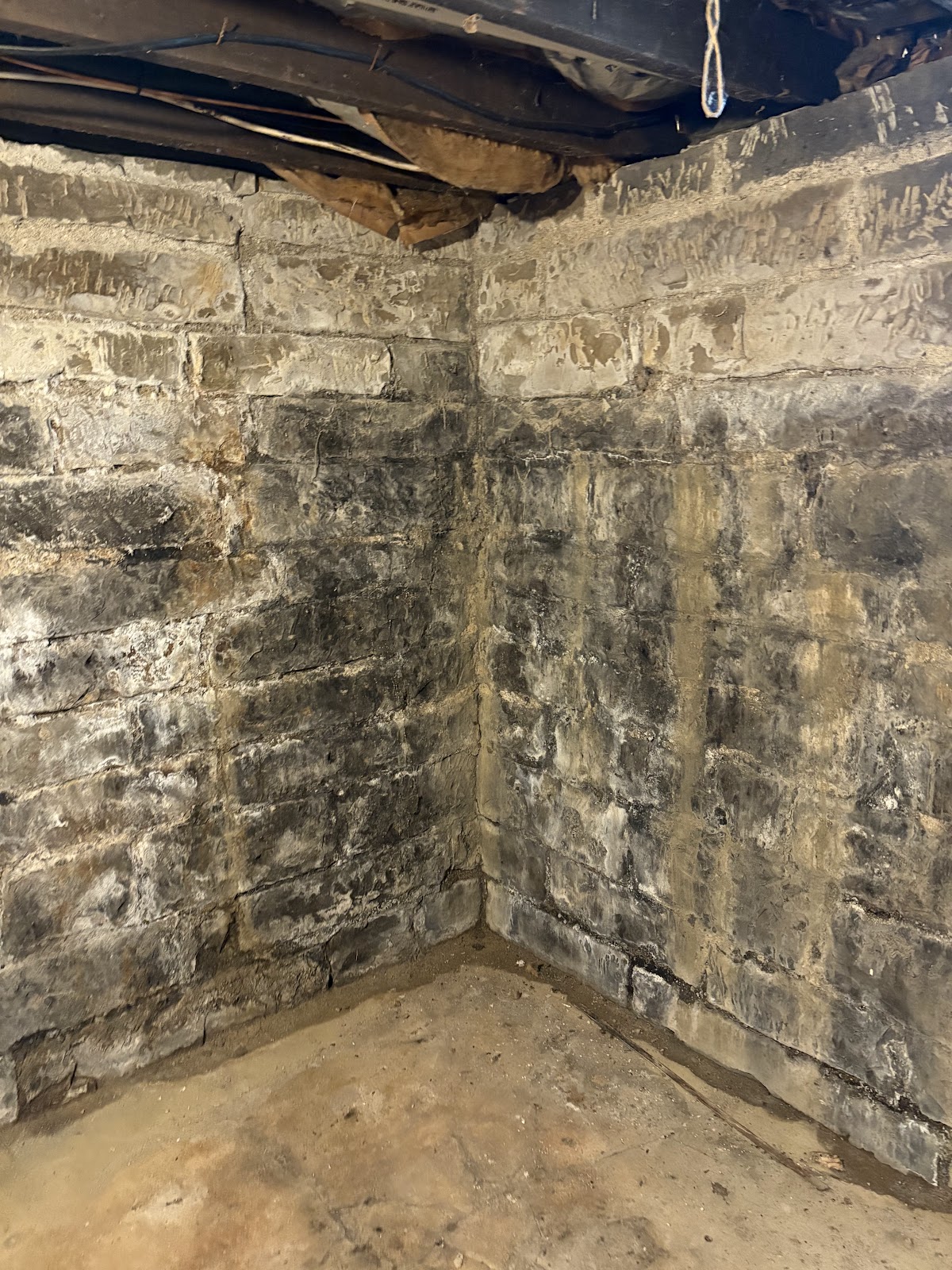
Mildew vs. Mold on Drywall — How to Tell the Difference
Mildew on drywall is a flat, powdery surface growth that wipes off and stays gone. Mold is fuzzy, slimy, or velvety, returns within days of cleaning, and feeds on the paint film or paper backing. The difference matters because mildew is a paint-film nuisance and mold is a substrate problem — they do not get the same treatment.
How to Spot Mildew on Drywall
- Flat, powdery, or chalky texture — never fuzzy or slimy.
- Gray to white discoloration, sometimes light yellow.
- Wipes off completely with a damp cloth.
- Does not return for weeks or months after cleaning.
- Stays on the paint film — never penetrates the paper backing.
- Common in bathrooms after humid showers.
How to Spot Mold on Drywall
- Fuzzy, slimy, velvety, or stringy texture.
- Black, green, white, pink, gray-brown, or yellow.
- Wipes off the surface but the colony remains.
- Returns within days of surface cleaning.
- Often shows the same pattern from the back side of the wall.
- Typically tracks back to a moisture source — leak, condensation, or flood.
For deeper disambiguation, read our mold vs. mildew identification guide — it covers the visual cues, the smell test, and what each finding means for the surface underneath.
Cleaned the spot but it came back? That is the colony talking. Surface cleaning fails when mold has reached the paper backing of paper-faced gypsum. Call 614-810-0000 for a Columbus assessment.
Where Mold on Drywall Shows Up in Columbus Homes
Drywall mold tracks moisture, and moisture in Central Ohio follows three predictable paths: bathroom humidity, basement-wall condensation, and ceiling leaks from above. The location of the discoloration is the strongest single clue to its source — and the source dictates whether cleaning will hold or whether the panel comes out.
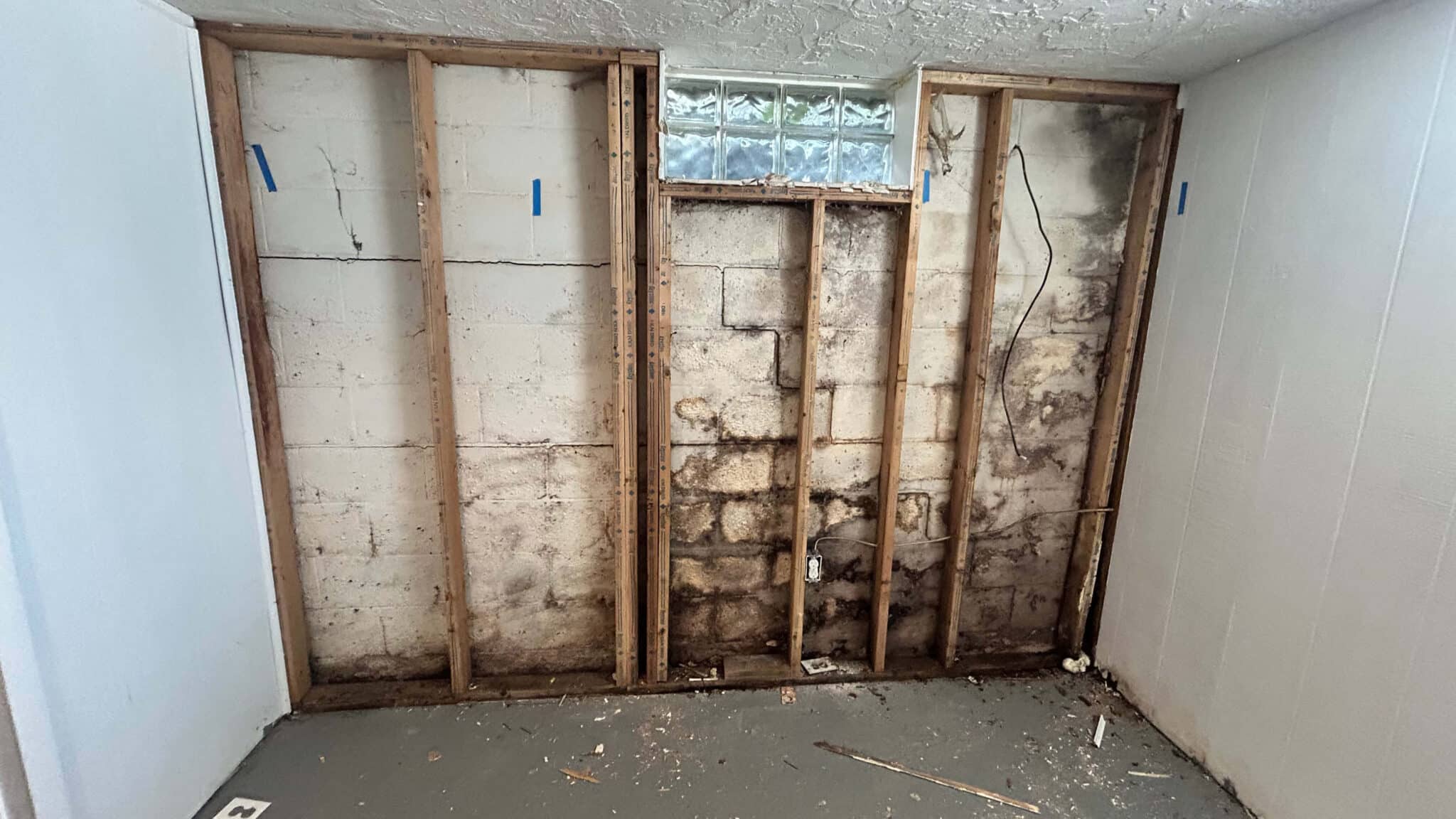
Mold on Drywall in the Bathroom
Bathroom drywall mold concentrates around the shower/tub surround, the ceiling above the shower, the wall behind the toilet, and the lower edges of any wall that meets the tub. The driver is sustained humidity above 60% RH without adequate exhaust ventilation. Pink, orange, and black colonies are most common.
Greenboard (moisture-resistant drywall) helps but is not mold-proof — the paper face still feeds mold under chronic wet conditions. The fix usually pairs panel replacement (where colonized) with an upsized exhaust fan vented to the exterior, not into the attic.
Mold on Drywall Ceiling
Ceiling drywall mold almost always indicates moisture from above — a roof leak, an ice dam, a bathroom vent dumping into the attic, an HVAC condensate line backup, or an upstairs plumbing failure. A circular brown ring with a darker center is the classic roof-leak signature. Linear streaking along ceiling joists points to attic ventilation or vapor-barrier failure.
Ceiling drywall takes paint poorly after a soak-and-dry cycle, and the paper face delaminates — replacement is far more common than cleaning in Columbus jobs. See also our guide to attic mold remediation when the source traces upward.

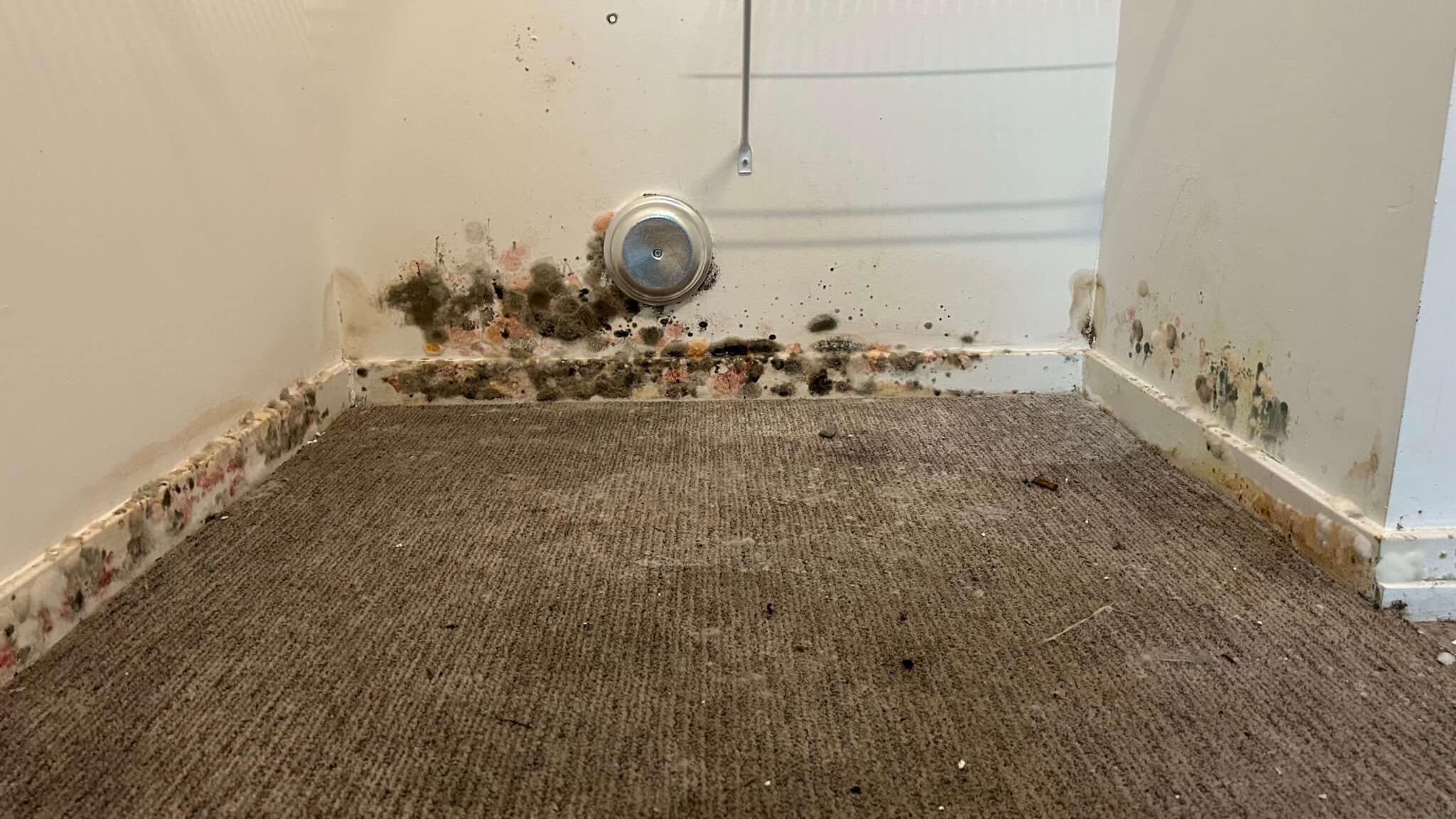
Mold on Drywall in the Basement
Finished-basement drywall mold appears along the lower 18–24 inches of exterior walls, behind furniture pushed against an exterior wall, and around the foundation rim. Drivers: foundation moisture wicking through framing, RH above 60% through humid Central Ohio summers, and finished-basement assemblies built without adequate vapor management.
White, gray, and black molds dominate. Whole-basement scope routes to basement mold remediation in Columbus.
Mold on Drywall Behind Furniture and Along Exterior Walls
Furniture pushed tight against an exterior wall blocks airflow and lets indoor humidity reach dew point on the wall surface. Result: a furniture-shaped mold pattern, often gray or olive, visible only when the furniture is moved.
The fix is partly architectural (insulation, vapor barriers) and partly behavioral — pull furniture 2–3 inches off exterior walls and run a dehumidifier in summer.
Mold Under Paint on Drywall

You suspect mold but the wall has been painted — sometimes recently, sometimes years ago. The diagnostic protocol has three steps:
- Probe test. Drill a small hole behind a future cover plate and inspect the paper backing.
- Moisture meter reading. Pin-style meter on the affected wall versus a known-dry reference wall.
- Back-side check. Pull an outlet plate, check from the attic, or inspect from an adjacent closet.
If the moisture reading is elevated and the back-side check shows colonization, no surface treatment will reach the colony. Painting over mold — including with mold-killing primers — does not solve the problem on paper-faced gypsum. ASTM D3273 measures coating resistance, not remediation.
Bathroom or basement drywall job? Skip the spray-and-pray route — call 614-810-0000 and let us look at the moisture source first.
The Bright-Line Rule: Surface Mold vs. Paper-Side Mold
Paper-faced gypsum drywall has cellulose paper on both faces — and paper is mold food. Mold living on the paint film alone is cleanable. Mold that has rooted into the paper backing or the gypsum core is not. This single distinction decides whether the panel stays or comes out, and competitors gloss over it. Make this your spine.
Surface Mold on Drywall
The colony is sitting on the latex paint film. Color may have stained the paint, but the paper backing is intact and dry. Affected area is small — under 10 square feet. There is no history of standing water, sewage, or sustained wetting. Treatment: HEPA vacuum, hydrogen peroxide or vinegar wipe, dry, repaint with a quality acrylic primer.
Paper-Side or Core-Penetrating Mold
The colony has rooted into the paper face or the gypsum core. Visual signals: discoloration that returns within days of cleaning, dark patches visible from the back side, paper that lifts under light pressure, soft gypsum, musty odor that returns after surface cleaning. Any post-flood (Cat 2/3) drywall is paper-side until proven otherwise.
Drywall Types — Not All Are Equal
Different drywall products handle moisture differently. The substrate framework decides what the paper-side rule means in your wall:
- Regular gypsum (paper-faced). The default residential drywall. Paper backing on both faces. Highest mold risk. Standard in most pre-2010 Columbus housing.
- Type-X (fire-rated) drywall. Paper-faced as well. Same mold-risk profile as regular gypsum. Common in garages, utility rooms, and party walls.
- Greenboard (moisture-resistant). Paper-faced with water-resistant additives. More tolerant of intermittent splashes — not mold-proof. Code allows it in some bathroom locations but not in continuous wet areas.
- Paperless / fiberglass-faced gypsum (e.g., DensArmor, ToughRock). No cellulose paper to feed mold. Mold-resistant by design. The current best practice for bathrooms, basements, and any moisture-prone wall.
- Blueboard (veneer plaster base). Found in older Columbus housing — German Village, parts of Clintonville. Different repair pattern; treat any mold finding as a substrate-specific job.
If you are replacing colonized panels in a moisture-prone area, paperless gypsum is the upgrade move. The material cost is higher; the long-term resilience is worth it.

Common Mold Species Found on Columbus Drywall
Seven species account for the vast majority of drywall mold cases in Columbus homes. Visual identification narrows the field; lab analysis confirms it. The species below are listed with the colors and locations where each is most often documented in our Central Ohio job records and in EPA / CDC indoor mold guidance.
Stachybotrys chartarum
Slimy black-green colonies on chronically wet paper-faced gypsum. The species most people mean when they say "toxic black mold." Produces mycotoxins under sustained wet conditions and warrants professional removal. Paper-faced drywall is its preferred substrate. Almost always paired with paper-side colonization.
Cladosporium
Olive-green to black, velvety. The most common mold worldwide and the most common dark mold on Columbus drywall. Tolerates a wide moisture range. Frequently misidentified as Stachybotrys. Cleanable on paint film; paper-side cases get the panel-replacement treatment.
Aspergillus
Yellow-green, dark green, or black depending on subspecies. Common on bathroom drywall and around HVAC supply lines. Aspergillus niger appears black and is often mistaken for Stachybotrys on visual ID alone. Allergenic; some species are pathogenic in immunocompromised individuals (per CDC indoor mold guidance).
Penicillium
Blue-green to white, powdery. Tolerates lower indoor RH than most molds — it can colonize drywall paper at sustained 60% RH without standing water. Dominant in finished Columbus basements that lack dehumidification through humid summer stretches.
Chaetomium
Cottony white that ages to gray and then olive-black. A water-damage signature species — almost always points to a chronic wet event. Common after sump-pump failures, slow supply-line leaks, and unrepaired roof leaks. Indicates the substrate is heavily compromised; replacement is the standard.
Alternaria
Gray-brown to black, fuzzy or wooly. Outdoor mold that colonizes indoor drywall on cold-side exterior walls, especially around window frames and along the cold lines where studs sit behind the drywall. Allergenic. Pattern points to condensation, not a leak.
Aureobasidium
Pink or salmon early; turns dark brown to black with age. The pink ring around bathroom drywall and tub surrounds. True mold (not the same as Serratia bacterium, which can also appear pink). Cleanable on paint film; pair with bathroom ventilation upgrade to prevent return.
For visual identification beyond the gallery above, read our black mold removal guide for Columbus — it covers Stachybotrys-specific protocols and what to expect from professional removal.
How to Kill Mold on Drywall (and What Doesn't Work)
For surface mold on the paint film — under 10 square feet, no paper-side involvement, no Cat 2/3 water history — hydrogen peroxide or distilled white vinegar will handle the kill. For paper-side colonization, no spray reaches the colony. The panel comes out. The treatment depends on the depth, not the color.
Hydrogen Peroxide, Vinegar, and Surface Cleaning
For confirmed surface mold under 10 square feet, the EPA-aligned approach is straightforward:
- Contain the area. Close interior doors, run a fan blowing outward through a window. Wear an N95 respirator and gloves.
- HEPA vacuum the visible growth. Standard shop vacs spread spores. Use a HEPA-rated unit.
- Spray and dwell. 3–10% hydrogen peroxide or undiluted distilled white vinegar. Let it sit for 10 minutes — do not over-saturate paper-faced gypsum.
- Wipe and dry. Clean cloths, one direction, do not scrub spores back into the paint film. Run a fan until the area reads dry on a moisture meter.
- Prime and repaint. A quality acrylic primer (or shellac-based primer for stain block) under a fresh coat of paint. Skip the primer step and the stain bleeds through.
Why Bleach Doesn't Work on Paper-Faced Gypsum
Sodium hypochlorite (household bleach) bleaches the visible discoloration but does a poor job killing mold on porous surfaces. Worse, the water carrier penetrates the paper face and feeds the colony deeper. EPA's mold guidance specifically recommends against bleach for routine mold cleanup. On paper-faced drywall, bleach makes the cosmetic problem disappear and the substrate problem worse.
Can You Paint Over Mold on Drywall?
No — not on paper-faced gypsum. Paint over mold — including products marketed as "mold-killing primers" — does not solve the problem. The colony continues feeding on the paper backing and works its way through new paint within months.
Antimicrobial encapsulant has a place AFTER source removal and substrate cleaning, not as a substitute for them. ASTM D3273 measures a coating's resistance to new mold growth, not remediation of an active colony.
How to Get Rid of Mold on Drywall — Step by Step
For surface mold the DIY workflow above handles it. For anything that fails the surface-vs-paper-side test, the workflow is professional remediation to IICRC S520 standards:
- Set up containment (heavy plastic sheeting plus a HEPA-filtered air machine that pulls air outward so spores don't drift into the rest of the home).
- HEPA-filter the workspace.
- Cut and remove colonized panels in marked sections, double-bag for disposal.
- Inspect, HEPA-vacuum, and treat exposed framing — replace any rotted or heavily colonized framing members.
- Apply antimicrobial encapsulant to remaining substrate.
- Run dehumidification until the cavity is documented dry.
- Reinstall paperless gypsum or moisture-resistant board where appropriate.
- Hand off for third-party Post-Remediation Verification (PRV) clearance — an independent testing company for objectivity.
How to Kill Black Mold on Drywall Specifically
Black mold on drywall is treated by depth, not by color. Cladosporium on the paint film follows the surface workflow above. Stachybotrys chartarum almost always involves paper-side colonization on chronically wet paper-faced gypsum — the panel comes out under containment.
Visual identification cannot reliably distinguish the two. If the black colony is slimy or velvety, returns after cleaning, or appears alongside any water-damage history, route it through professional remediation.
Best Way to Kill Mold on Drywall — Spray Products and Their Limits
Commercial mold sprays (RMR-86, Concrobium, Mold Armor) generally do what hydrogen peroxide and vinegar do at higher cost. None of them reach the paper backing. None of them substitute for source removal. They are reasonable tools for the surface-mold-under-10-square-feet case; they are not a remediation strategy for paper-side colonization or post-flood drywall. Read the label, use a respirator, ventilate.
Spray-and-pray didn't hold? The colony is in the paper. Get a Columbus assessment performed to IICRC S520 standards — 614-810-0000.
Is Black Mold on Drywall Dangerous?
Per EPA guidance, all indoor mold should be removed regardless of species. Several common molds appear black on drywall — Cladosporium, Aspergillus niger, and Stachybotrys chartarum. Visual identification cannot tell them apart. Stachybotrys produces mycotoxins under sustained wet conditions and warrants professional removal. Surface area and substrate involvement decide the action level, not color alone.
Per the EPA Brief Guide to Mold, Moisture, and Your Home: areas larger than 10 square feet should be handled by professionals trained in mold remediation. CDC indoor mold guidance points the same direction — mold exposure can affect Indoor Air Quality (IAQ), and the appropriate response is removal of the colony and correction of the moisture source.
This page does not diagnose health conditions. If household members are experiencing symptoms they associate with indoor mold exposure, consult a healthcare provider. iDry Columbus provides assessment, source identification, and remediation to IICRC S520 standards — not medical advice. Looking for the species-specific protocol for slimy black mold? See our black mold removal in Columbus guide.
When to Replace Drywall: Three Decision Rules
Hit any one of these three thresholds and the drywall comes out. Below all three, surface treatment usually holds. The rules are derived from IICRC S520 (mold remediation), IICRC S500 (water damage classification), and EPA mold-remediation guidance — combined into a homeowner-readable decision framework.

-
Rule 1 — Affected area greater than 10 square feet.
Per EPA guidance, mold-affected areas larger than 10 square feet should be handled by trained remediation professionals. Above this threshold, DIY containment fails and spore distribution becomes the bigger risk than the original colony. Measure the visible discoloration plus a 12-inch margin in every direction — that is the working area.
-
Rule 2 — Paper-side colonization is confirmed or suspected.
Paper-side mold cannot be reached by surface treatment. Confirmation methods: visible growth from the back side, growth that returns within days of cleaning, paper that lifts or pills under light pressure, soft gypsum behind the paint, persistent musty odor after surface cleaning. Any one of these is enough — the panel comes out.
-
Rule 3 — Cat 2 or Cat 3 water exposure of any duration.
Per IICRC S500, Category 2 (gray water from appliance discharge, washing machine overflow, sump-pump backup) and Category 3 (black water from sewage, flooding, storm water) drywall is treated as contaminated. Cat 2 drywall older than 48 hours and Cat 3 of any age comes out, mold or no mold.
The Mold Remediation Process for Drywall (IICRC S520 Standard)
Professional drywall mold remediation follows a five-phase sequence: assessment, containment, removal, reconstruction, and verification. Skipping any phase is how a single-panel job becomes a whole-floor remediation. The sequence below is how iDry Columbus runs every drywall remediation, performed to IICRC S520 standards.
Phase 1 — Assessment & Moisture Mapping
Visual inspection, moisture-meter mapping behind paint and along framing, identification of the moisture source, scope sketch with affected square footage. The moisture source is the single most important finding — if you remediate the mold without correcting the source, the colony returns within months.
Phase 2 — Containment & HEPA Air Filtration
Heavy plastic sheeting around the work area plus a HEPA-filtered air machine that pulls air outward (so spores can't drift into the rest of the home), with a sealed pass-through for tools. Cat 2 / Condition 2 jobs need full containment; Cat 3 adds a sealed entry chamber.
Phase 3 — Source Removal
Score and cut colonized drywall panels in marked sections, double-bag for disposal, remove wet insulation behind colonized panels, HEPA-vacuum exposed framing, treat sound framing with antimicrobial — replace any framing members that are rotted or heavily colonized.
Phase 4 — Drying & Reconstruction
Dehumidification until the cavity is documented dry on a moisture meter, antimicrobial encapsulant on remaining substrate, reinstall paperless gypsum (or moisture-resistant greenboard depending on location), tape, mud, prime, paint. The reconstruction phase upgrades the substrate where appropriate — the original failure is the lesson.
Phase 5 — Post-Remediation Verification (PRV)
Independent third-party clearance testing — air sampling and visual verification that the remediation meets IICRC S520 Condition 1 standard. iDry refers PRV to a licensed third-party testing company to keep the verification objective. The clearance document is what you hand to the buyer, the adjuster, or the next tenant.

For the full residential pillar, see our Columbus mold remediation services overview. For drywall jobs that are part of a larger framing or structural mold case, see mold on wood framing and floors. For drywall mold tied to masonry foundation issues, see mold on brick and masonry.
Columbus Humidity, Housing Stock, and Why Drywall Mold Runs Ahead of Expectation
Central Ohio summer dew points routinely cross 70°F from June through August. Indoor RH in finished basements without dehumidification holds at 65–75% through the humid stretch — well above the 60% threshold where drywall paper face becomes mold-supportive.
The Columbus housing stock makes it worse: post-WWII original drywall, finished basements built before vapor-barrier code matured, and exterior walls where the studs behind the drywall stay colder than the rest of the wall in winter (those cold lines pull condensation out of the indoor air, and that condensation feeds mold).
Post-WWII Drywall Housing in Bexley, Clintonville, Upper Arlington
The Columbus building boom ran 1946–1970 — the era when paper-faced gypsum drywall replaced lath-and-plaster as the residential standard. These walls are now 55–80 years old. Many are still original drywall behind newer paint. Bexley, Clintonville, Upper Arlington, and parts of Worthington carry the highest exposure.
Substrate-related water damage often pairs with the mold finding — see our Columbus water damage restoration overview when both are in play.
Finished Basements in Worthington, Reynoldsburg, Pickerington, Hilliard
Below-grade construction in these suburbs leans heavily on sump-pump-dependent assemblies. A sump failure during a heavy storm event saturates the lower 12–18 inches of drywall before the homeowner notices. Even without a flood, the steady-state humidity gradient in a finished basement holds the bottom of the wall in a mold-supportive band through summer.
New-Build Communities in Dublin, New Albany, Powell
Engineered drywall, paperless gypsum, and modern vapor barriers shift the baseline mold risk down. Most cases here trace to bathroom ventilation problems, attic-to-bathroom vent routing failures, and HVAC condensate-line backups — not the systemic basement-wall mold pattern of the older suburbs. Suspected mold but unsure of scope? A Columbus mold inspection tells you whether the problem is surface-level or structural.
German Village and Pre-Drywall-Era Housing
Many German Village and downtown Columbus homes predate the drywall era. Plaster-on-lath and blueboard veneer-plaster systems behave differently — treat any mold finding as a substrate-specific job. The visual cues are similar but the repair pattern is different.
For the broader regional risk picture, see our Columbus neighborhood mold risk index.
The threshold above which drywall paper face becomes mold-supportive. Finished Columbus basements without dehumidification routinely hold 65–75% RH through humid summer stretches.
Cost to Remove or Replace Mold-Affected Drywall (Cat 1 / 2 / 3)
Drywall mold remediation cost in Columbus tracks severity, not square footage. The Cat 1 / 2 / 3 classification from IICRC S500 (water) combined with the Condition 1 / 2 / 3 classification from IICRC S520 (mold) determines the scope — and the scope determines the cost band.
Band framing replaces fixed dollar figures because material costs and crew availability shift through the year. Call for a same-day Columbus quote tied to your actual conditions.
Cat 1 / Condition 1 — Surface mold, < 10 sq ft
Low Band
Surface clean + treatment + repaint. DIY-feasible or low-end professional service. Generally not an insurance claim — under deductible. Common case: single bathroom drywall panel with surface mold from a humid stretch.
Cat 2 / Condition 2 — Paper-side, localized
Mid Band
Containment + drywall demo + framing treatment + replacement + finish. IICRC S520 remediation scope. Possible insurance claim if a sudden water event triggered the moisture — appliance discharge, supply-line failure.
Cat 3 / Condition 3 — Widespread, structural
High Band
Major demo + framing remediation + replacement + Post-Remediation Verification. Insurance claim category — sudden water event with full S500 / S520 documentation. Common after sewage backups, river flooding, and unrepaired roof or supply-line failures.
Bathroom Drywall — Chronic Moisture
Low – Mid Band
Targeted demo, paperless gypsum replacement, ventilation upgrade. Generally insurance-excluded (gradual cause). Pair with bathroom exhaust-fan correction to break the cycle.
Ceiling Drywall — Roof Leak / Ice Dam
Mid – High Band
Demo + framing inspection + insulation check + replacement. Often covered when the leak is sudden and reported promptly. Pair with roof and attic-vent assessment to prevent recurrence.
Exterior Cold-Side Wall — Condensation
Mid Band
Demo + vapor-barrier review + paperless replacement. Generally insurance-excluded (gradual / maintenance). Pair with an insulation upgrade so the cold stud lines behind the drywall stop pulling condensation out of the indoor air.
For the full Columbus pricing context, see our Columbus mold remediation cost guide. For drywall water-damage repair without mold, the workflow and pricing route differently — our mold remediation services page covers the boundary.
Insurance and Mold-Damaged Drywall: Sudden vs. Gradual
Coverage for mold-damaged drywall hinges on the cause of loss. Mold from a sudden, accidental water event — burst pipe, washing-machine hose, supply line failure, appliance discharge — is typically covered, with a mold sub-limit (commonly $5,000 to $10,000 unless endorsed higher).
Mold from gradual leaks, high humidity, or deferred maintenance is generally excluded. Major Columbus carriers — State Farm, Allstate, Erie, Nationwide, USAA, Liberty Mutual — all use the sudden-vs-gradual distinction.
Documenting the Claim
The adjuster examines scope of loss, the claim number, and whether the moisture event qualifies under the policy. Documentation that moves the claim: the date and source of the water event, photos before disturbance, the IICRC S500 / S520 scope, the schedule of loss, and the Post-Remediation Verification (PRV) report.
Replacement cost vs. actual cash value (ACV) on contents and finishes is set by the policy form — ask the adjuster to confirm which applies before signing the scope.
The Mold Sub-Limit and Coverage Limit
Most homeowners forms cap mold-related remediation at a sub-limit even when the underlying water claim is fully covered. Common sub-limits: $5,000 default, $10,000 with an endorsement, higher with specialty coverage. Read the declarations page or call the carrier to confirm. The deductible applies to the overall claim, not separately to the mold sub-limit.
Subrogation and Third-Party Cause
If a third party caused the moisture event — a contractor's failed plumbing repair, a neighbor's overflow into your wall, a manufactured product failure — the carrier may pursue subrogation against that party after paying your claim. Document the cause carefully; subrogation can preserve your no-claims discount and reset your deductible.
For the broader insurance coordination workflow, see our mold remediation insurance guide for Columbus. Boundary case: if the moisture event was a basement flood without mold yet, that's flooded basement cleanup; if the basement assembly is now mold-affected after the dry-out, this page applies.
Adjuster wants an IICRC scope? Call 614-810-0000 — we deliver the S500 / S520 scope of loss in the format Columbus adjusters expect. For HVAC-driven mold downstream of a condensate-line failure, see HVAC mold removal in Columbus.
What Columbus Homeowners Say About iDry
-
Stacy Connelly ★★★★★
We had a mold problem in our basement that two other companies failed to fix properly. iDry came in, identified the source of moisture, and remediated everything correctly. The musty smell is completely gone and the basement is dry. Professional, on time, and fair pricing.
-
Kendra Turner ★★★★★
iDry Columbus went above and beyond for my family when we had a water emergency. They responded quickly, communicated clearly through the whole process, and left our home in great shape. Curtis and the team treated us like family — not just another job.
-
David Warner ★★★★★
The way Curtis and his crew handled our situation was old school in the best way — honest, respectful, and thorough. They cleaned out years of buildup without judgment and left the property ready for renovation. Communication was clear from start to finish.
Related Mold and Drywall Resources
Drywall mold rarely lives alone. Use these companion guides for adjacent substrates, locations, and scope — or call 614-810-0000 for direct help now.
-
Pillar
Columbus Mold Remediation Services
The full residential and commercial overview — assessment, containment, removal, reconstruction, and PRV clearance. The pillar this page belongs to.
-
Species
Black Mold Removal in Columbus
Species-specific protocols for Stachybotrys and the other dark molds — what to expect from professional removal.
-
Location
Basement Mold Remediation
Whole-basement scope — finished walls, framing, vapor management, sump-pump-driven moisture, dehumidification.
-
Location
Attic Mold Remediation
Sheathing-side mold, ice-dam patterns, attic ventilation failures, and the cases where ceiling drywall mold traces upward.
-
Cost
Columbus Mold Remediation Cost
The full Cat 1 / 2 / 3 cost framework, scope drivers, and what changes the band — beyond the drywall sub-section.
-
Inspection
Mold Inspection in Columbus
Visual assessment, moisture mapping, source identification — what comes before testing or remediation.




Frequently Asked Questions — Mold on Drywall
Real questions Columbus homeowners ask about drywall mold. Answered directly — no filler.
What should I do if I find mold on drywall?
Don't paint over it, don't bleach it, don't panic. Two things to check: is the mold sitting on the paint film, or has it pushed through to the paper backing? And is the patch bigger or smaller than a sheet of printer paper? Paint-only and small, you can handle it. Paper-side or bigger, that's a Columbus callout — 614-810-0000.
Does drywall with mold always need to be replaced?
Not always. The line I draw is whether mold has reached the paper backing. Paint-only under about ten square feet — wipe, dry, prime, repaint. Once mold roots into the paper, no spray reaches the colony. In older Bexley and Clintonville drywall I see this constantly. When that happens, the panel comes out and a fresh one goes in.
Is black mold on drywall actually dangerous?
Honest answer: depends on the species, and you can't tell which one by looking. Three molds show up black around Columbus — Cladosporium, Aspergillus, and Stachybotrys chartarum, the one people mean by "toxic black mold." Stachybotrys can produce mycotoxins when things stay wet. The EPA's position — and ours — is that any indoor mold gets removed.
What's the difference between mildew and mold on drywall?
Easiest field test: how does it come off? Mildew is flat, powdery, gray-or-white — wipe it with a damp cloth and it's gone. Mold is fuzzier or slimier and comes back within a week or two because the colony has rooted in. A dab of hydrogen peroxide settles it: stays gone in a Columbus bathroom is mildew, returns is mold.
Can you just paint over mold on drywall?
No, and the "mold-killing primer" products at the hardware store feed the confusion. Those primers resist new mold on the paint film — they don't kill an active colony living in the paper behind your drywall. I've torn into more painted-over walls in Columbus than I can count. Mold's always still there, paint bubbling within months.
What kills mold on drywall — and what doesn't?
Surface mold on a small Columbus bathroom or basement panel? Hydrogen peroxide or plain white vinegar on a dry surface kills what's killable from the front. Don't use bleach — it whitens the stain so the mold looks gone, but the water carries spores deeper. Cat 2 / Cat 3 water is a professional remediation job.
Does Columbus humidity actually make drywall mold worse?
Yes. Central Ohio summer dew points cross 70°F June through August — humidity that doesn't show on a thermostat but absolutely shows on your drywall. Finished basements in Bexley, Worthington, Reynoldsburg, and Pickerington without dehumidifiers run 65 to 75% relative humidity all summer. Drywall paper feeds mold above 60% RH. Older post-WWII Columbus drywall gets hit hardest.
Does homeowners insurance cover mold-damaged drywall?
Sometimes — it hinges on one word: "sudden." Mold from a burst pipe, washing-machine hose, or supply-line break is usually covered, with a mold sub-limit around $5,000 to $10,000 unless endorsed. Mold from gradual leaks or humidity is typically excluded. Every major Columbus carrier — State Farm, Allstate, Erie, Nationwide, USAA — uses the same sudden-vs-gradual line.
How long does it take for mold to grow on drywall after a leak?
Faster than most people think. Textbook is 24 to 48 hours after drywall paper gets and stays wet — that's what we see in the field. Columbus humidity, especially May through September across Dublin, Westerville, and Hilliard, shortens that window. Per IICRC S500, drywall wet more than 48 hours after Cat 2 or Cat 3 water is treated as compromised.
How much does it cost to replace mold-damaged drywall in Columbus?
Cost tracks severity more than square footage. A single bathroom panel with surface mold in Upper Arlington or German Village — low band. Cat 2 paper-side work with localized demo — mid band. Full Cat 3 with widespread structural impact and verification testing — high band. We don't quote sight-unseen. Full breakdown in our Columbus mold cost guide.
Request a Columbus Drywall Mold Assessment
Tell us what you found and where. We will call back to schedule an on-site assessment, walk the moisture source with you, and give you a written scope. Same-day availability in most cases. For immediate help, call 614-810-0000.
Drywall Mold Remediation Service Area — Columbus and Suburbs
Drywall mold remediation runs across Columbus and the surrounding Franklin County suburbs. Same-day scheduling is available within the Columbus metro. 30+ years of restoration work across every Columbus neighborhood — the construction eras, the moisture patterns, and the species that thrive on local drywall are familiar territory.
Also serving: Lewis Center, Delaware, Johnstown, Whitehall, Canal Winchester, Pataskala, Sunbury, Marysville, Lancaster — all of Franklin County and surrounding Central Ohio communities.