
By Curtis Teets, owner and operator, iDry Columbus · Last reviewed .
Flooded Carpet Drying in Columbus, OH — Save vs. Discard, Mold Risk & Professional Process
Carpet flooded right now? Stop here. The next 24 to 48 hours decide whether it can be saved. iDry Columbus extracts, dries, and salvages Category 1 carpet about 85 to 90% of the time when we are called inside that window. Call 614-810-0000 — available 24/7 across Columbus and surrounding suburbs.

Real Columbus wet-carpet guidance from Curtis Teets, owner and operator of iDry Columbus — 30+ years across Bexley, Dublin, Westerville, Hilliard, Upper Arlington, Worthington, Gahanna, and surrounding Franklin County. All work performed to IICRC S500 (water damage) and S520 (mold remediation) industry standards. Call 614-810-0000.
The 3 Things to Do Right Now (and the 1 NOT to Do)
Soaked carpet, phone in hand — here is the action sequence before you scroll any further. What I tell folks calling at 2am is to do these three things in order, then call. Total time: under 15 minutes.

Do These Three Things Now
- Extract the standing water. Wet/dry shop vac, push-broom and squeegee toward a drain, or stack of old towels. Get visible water off the surface inside the first 60 minutes.
- Identify the source. Clean supply line break, washing machine, dishwasher, sump pump backup, or sewage backflow. The source decides whether the carpet saves or comes out.
- Lift a carpet edge in the corner. Pull back two feet to expose the pad and subfloor. This vents trapped moisture and lets you see how saturated the assembly is underneath.
Once those three actions are done, call us. Inside the 24 to 48 hour window, Category 1 (clean water) carpet saves at iDry about 85 to 90% of the time. Past 48 hours the math changes fast — mold colonizes the pad and the salvage decision flips.
The Quick Save-vs-Discard Test
Three questions answer it almost every time. Was the water clean (supply line, rain, ice maker)? Has the carpet been wet less than 48 hours? Is the pad still intact (not delaminated or shedding)? Three yeses means the carpet is a save candidate. One no means call before any DIY drying attempt.
Can Your Carpet Be Saved? The IICRC S500 Cat 1 / 2 / 3 Decision
The IICRC S500 standard splits every water loss into three categories — clean, gray, and black — and the category decides whether carpet saves or comes out. No top-10 result on this query walks the framework cleanly. We do, because it is the safety-critical call.
Cat 1 (clean water) is sanitary at the source: supply line break, ice maker, hot water tank, clean rainwater. Cat 2 (gray water) has contamination: dishwasher, washing machine overflow, sump-pump backup, toilet overflow without solids. Cat 3 (black water) is grossly contaminated: sewage backup, river or storm flood, toilet overflow with solids.
Category 1 — Clean Water (Usually Save)
~85-90% Save Rate
Clean water from a sanitary source. Supply line, ice maker, tub overflow, rainwater. Caught inside 48 hours, the face fiber and backing dry in place with extraction plus an LGR dehumidifier. The pad usually salvages on Cat 1.
Category 2 — Gray Water (Case by Case)
~55-65% Save Rate
Significant contamination. Dishwasher, washing machine, sump-pump backup, aquarium, toilet without solids. Face fiber sanitizes. Pad almost always replaces. Float-dry plus antimicrobial application required — not a DIY scope.
Category 3 — Black Water (Mandatory Discard)
0% (No Exceptions)
Sewage backup, storm flood, toilet with solids, standing water beyond 72 hours with biological growth. IICRC S500 requires the carpet AND pad come out. Subfloor sanitized and antimicrobially treated. Reinstall with new materials.
Cat 1 Over 48 Hours (Discard)
Mold-Driven Discard
Even clean-source water loses its save status past 48 hours in Columbus humidity. Microbial amplification on the pad pushes the assembly to Cat 2 by category promotion. Pad replaces; carpet may save with sanitization.
The save-rate numbers above come from iDry's Columbus job log across 30+ years of restoration work. No competitor publishes this data because most do not track it. We do because it tells the homeowner the truth before we knock on the door.
For the broader water-loss framework across the silo, see our Columbus water damage restoration overview. For sewage-specific scope, see sewage backup cleanup.
Carpet vs. Pad — Why the Pad Almost Always Loses

Most articles treat carpet as one object. It is two: the face fiber and backing on top, and the foam pad underneath. Save decisions split between them, and the pad almost always loses on anything past Cat 1 inside the 48-hour window.
The pad is open-cell foam or rebond — an absorbent sponge sitting between carpet and subfloor. It holds water long after the face fiber feels dry to the touch. On Cat 1 jobs we sometimes save the pad with float-drying. On Cat 2 and Cat 3, the pad is always replaced.

Why the Pad Rule Matters for Cost
Replacing pad is far cheaper than replacing carpet. The pad runs roughly $0.30 to $0.80 per square foot in Columbus retail. Mid-grade carpet runs $3 to $7 per square foot installed. A pad-only swap on a Cat 2 job protects the carpet investment and prevents mold from anchoring underneath.
The Cushion Saturation Test
Lift a corner. Press a dry paper towel against the pad. Comes back wet means the pad is saturated. On Cat 1, pad-saturation means lift-and-float-dry. On Cat 2, pad-saturation means tear out and replace. On Cat 3, the pad comes out before any drying decision. No exceptions.
Why Secondary Backing Matters Too
Carpet has a face fiber, a primary backing, latex adhesive, and a secondary backing (usually jute or synthetic). Cat 2 and Cat 3 contamination wicks into the secondary backing and the latex layer. Sanitization reaches the face but cannot fully reach those interior layers — another reason Cat 3 is mandatory discard.
Pad saturated and not sure if the carpet saves? Lift one corner and call 614-810-0000. We give the call over the phone in 10 minutes after you send a photo.
The 24-48 Hour Mold Window — Why Columbus Humidity Shrinks It
Mold colonizes wet carpet inside 24 to 48 hours under typical indoor conditions. In Columbus that window shrinks. Average summer dewpoint here sits above 65°F from June through August, and finished basements hold 65 to 75% relative humidity without active dehumidification.
The species that show up first are predictable: Cladosporium, Penicillium, Aspergillus, and on prolonged moisture, Stachybotrys chartarum. Visual ID alone never confirms species. The point is that all four colonize wet carpet pad inside the same 24 to 48 hour window.

Why "Will It Dry on Its Own?" Is the Wrong Question
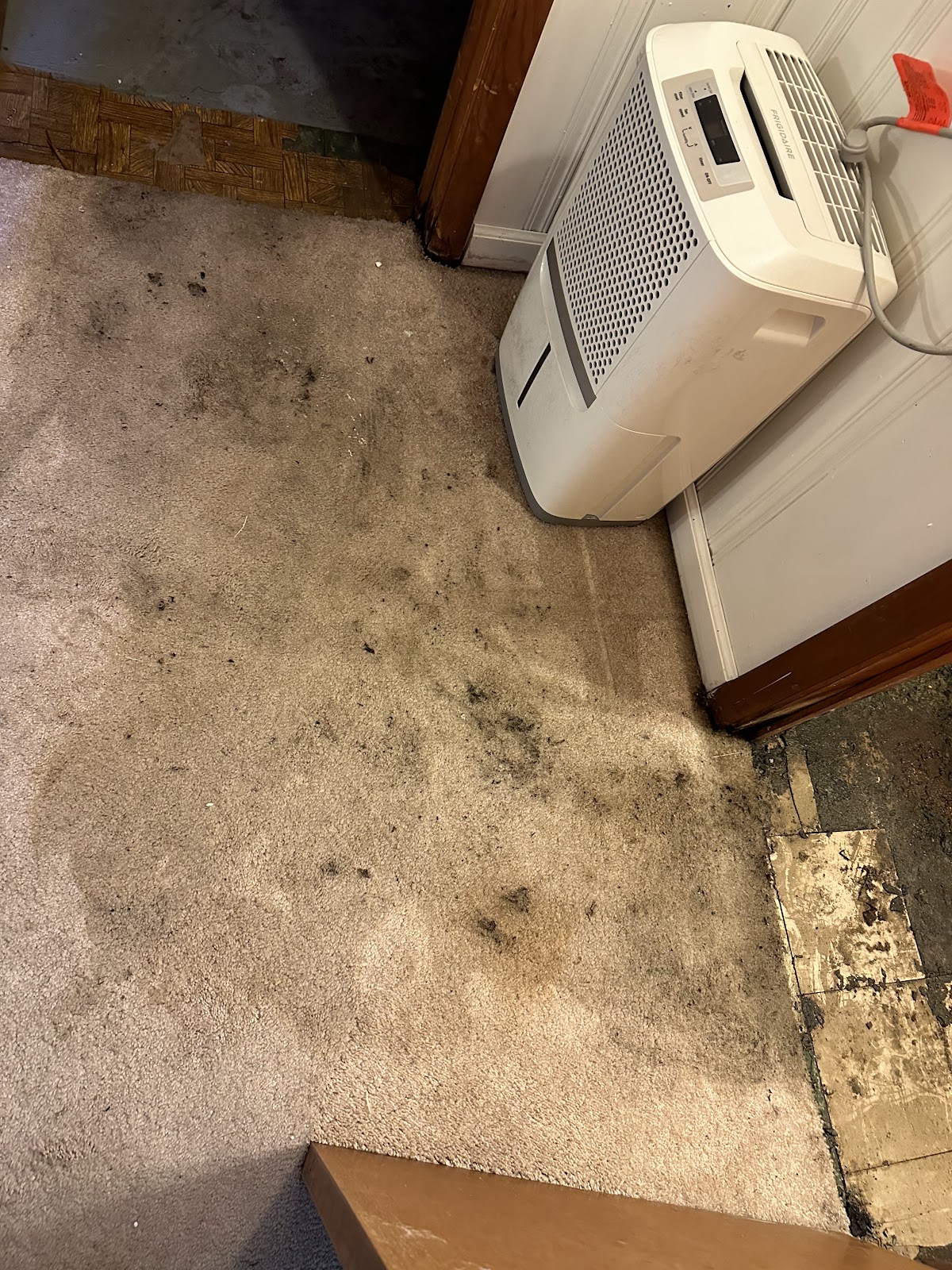
Honest answer: not in Columbus. Household airflow cannot pull enough moisture out of a saturated pad before mold colonizes. A wet carpet that "feels dry" on top often has a soaked pad and damp subfloor underneath. That is where the musty smell starts and where remediation costs balloon.
The Musty Smell Is Already Mold
By the time wet carpet smells musty, microbial volatile organic compounds are already off-gassing. Microbial amplification has crossed the threshold. Surface drying at this point will not solve it — the pad and the subfloor underneath need professional remediation.
Typical Columbus finished basement relative humidity through summer without active dehumidification. Mold needs free moisture and 60%+ ambient RH — both present after a carpet flood. Why DIY fans extend the problem instead of fixing it.
For the cluster pivot to mold-driven scope, see our Columbus mold remediation overview. Wet carpet pad that has crossed the window often becomes a basement mold remediation scope by the time the homeowner notices the smell. For the combined water-and-mold workflow, see water damage and mold.
Carpet wet more than 24 hours? Do not wait for the smell — call 614-810-0000 now. The window closes whether the homeowner is watching or not.
The Drying Process — How Pros Actually Do It
Professional carpet drying is a four-step process built on IICRC S500: extract, deploy equipment, monitor to drying standard, document. Household fans and a dehumidifier from the hardware store cannot match it on a saturated assembly.
Step 1 — Truck-Mounted Extraction
Truck-mounted extractors pull water out at 50 to 100 PSI — orders of magnitude more vacuum than any household wet/dry vac. On a saturated carpet, weighted-extraction wands compress the assembly to drive deep water out of the pad and secondary backing in one pass.
Step 2 — LGR Dehumidifier and Axial Air Mover Deployment
LGR (low-grain refrigerant) dehumidifiers pull moisture out of the air far below the threshold a household unit can hit. Axial air movers (one per 150 to 300 sq ft of affected carpet) push airflow across the surface. Together they create the psychrometric conditions for fast, controlled drying.

Step 3 — Daily Moisture Monitoring to Drying Standard
Every day on the job, technicians take penetrating moisture meter readings on the carpet, pad, and subfloor. Hygrometer readings on the room air. Goals are clear: carpet under 12% moisture content, pad and subfloor at the room baseline, RH below 50% before equipment comes out.
Step 4 — Clearance, Documentation, and Adjuster Handoff
The final readings become the dry-out documentation for the insurance file. Scope of loss in IICRC S500 format with claim number, materials, equipment days, and labor. Same documentation for your adjuster, your records, and any future buyer's inspection.
Float-Drying — The Cat 1 Pad-Save Method
On Cat 1 jobs where the pad is intact, we sometimes save it with float-drying. Lift one carpet edge, slide a hose under, and use airflow to inflate the carpet like a balloon. Both faces of the pad and carpet dry simultaneously. Skill-dependent but cheaper than tear-out plus reinstall.
For the moisture meter detail behind the daily monitoring, see our moisture meter reading chart. For the broader extraction workflow, see Columbus water extraction.
Cost of Wet Carpet Restoration in Columbus
Wet carpet drying in Columbus runs from a few hundred dollars on a small Cat 1 spill to multi-thousand-dollar Cat 3 sewage tear-outs. Category, square footage, and equipment days drive the band. Most of these are insurance claims — we work directly with your adjuster.
Five typical scope bands from real iDry Columbus callouts:
Cat 1 — Single Room
Low Band
Clean water, single room under 200 sq ft, caught inside 24 hours. Truck-mounted extraction, two air movers, LGR dehumidifier, two to four days of monitoring. Pad usually saves.
Cat 1 — Multi-Room or Basement
Mid Band
Clean water, multiple rooms or finished basement square footage. More air movers, more equipment days, possible pad-section replacement. Insurance-relevant scope on most jobs at this band.
Cat 2 — Gray Water
Mid-to-High Band
Washing machine, dishwasher, sump backup. Extraction, mandatory pad tear-out, antimicrobial application, structural drying, possible carpet replacement if dye-bleed or delamination. Almost always an insurance claim.
Cat 3 — Sewage / Storm
High Band
Sewage backflow or storm flood. Carpet and pad full tear-out, sealed disposal, subfloor sanitization, structural drying, antimicrobial, new carpet and pad install. Insurance-relevant. Rider-dependent on sewage backup.
Late Discovery (Past 48 Hours)
Mid-to-High Band
Wet carpet found beyond the 48-hour window. Mold remediation paired with the carpet scope — pad and subfloor remediation, possible drywall scope at the bottom plate. Pairs with our mold scope.
Extraction-Only Service
Low Band
Standing water removal only, customer handles drying. Sometimes the right call when the homeowner is willing to monitor moisture daily and the situation is squarely Cat 1 inside 24 hours.
For the full water-damage cost framework across every scope, see our Columbus water damage restoration cost guide.
Want a Columbus number for your situation? Send a photo to 614-810-0000 and we will give you a banded estimate over the phone.
Insurance Coverage for Wet Carpet Damage
Sudden, accidental water damage to carpet is typically covered by Ohio homeowners insurance — supply line break, washing machine overflow, sump pump failure with rider. Gradual leaks and external flood (without NFIP) are generally excluded. Major Columbus carriers all use the sudden-vs-gradual cause of loss distinction.
The adjuster examines four things on a wet-carpet claim: cause of loss (sudden vs. gradual), date of event, scope of loss documentation, and any IICRC S500 reference in the contractor scope. iDry delivers the scope of loss in the format Columbus adjusters expect.
Ohio Coverage Snapshot — Major Columbus Carriers
- State Farm. Covers sudden supply-line water damage. Sewage backup needs the optional rider. Standard Ohio deductible $500 to $2,500. ACV by default; replacement cost value (RCV) with endorsement.
- Allstate. Covers sudden water events. Sewage backup rider standard add-on. ACV or RCV per policy form. Mold sub-limit applies if drying delay causes mold.
- Erie Insurance. Covers sudden water. RCV common in Ohio Erie policies. Strong claim-handling reputation in Central Ohio. Sewage rider sold as Water and Sewer Backup endorsement.
- Nationwide. Columbus is Nationwide's home market. Covers sudden water. Sewage rider available. ACV default; RCV available with rider. Mold sub-limit standard.
- USAA. Military families. Covers sudden water with strong claim service. Subrogation pursued aggressively when a third party caused the loss (manufacturer defect, contractor failure).
- Liberty Mutual. Covers sudden water. Mold sub-limit standard. Sewage rider available. Standard Ohio deductible bands. Coverage limit per dwelling form.
- Westfield. Ohio-based regional carrier. Covers sudden water and offers sewage backup endorsement. RCV common. Strong local adjuster network.
- Progressive / Safeco. Covers sudden water per dwelling form. Sewage rider on optional schedule. Adjuster typically requests IICRC-format scope of loss.
Claim Vocabulary — Deductible, ACV vs. RCV, Subrogation, Sub-Limits
- Claim number. Issued by the carrier when you file. iDry references it on every report so the adjuster reconciles the file in one pass.
- Deductible. Standard Ohio runs $500 to $2,500. Applied to the overall claim, not to mold sub-limit separately. Small Cat 1 jobs sometimes land below the deductible.
- Scope of loss. Written line items the adjuster recognizes for payment. Demo, extraction, equipment days, materials, labor, schedule of loss for damaged contents.
- ACV vs. RCV. Actual Cash Value is replacement cost minus depreciation. Replacement Cost Value is what the work actually costs today. Older Bexley or Clintonville carpet has heavy depreciation under ACV.
- Subrogation. If a third party caused the loss — failed dishwasher hose, manufacturer defect, upstairs neighbor — your carrier pays then pursues recovery from the responsible party.
- Sewage backup rider. Standard policies do NOT cover sewer or sump backflow without this optional rider. Common gap that surprises Columbus homeowners on Cat 3 jobs.
- NFIP flood policy. Carpet flooded by external storm water requires a separate National Flood Insurance Program policy. Homeowners often discover this at claim time.
- Mold sub-limit. Mold damage commonly capped at $5,000 to $10,000 standard. Gradual mold from improperly dried carpet is often excluded entirely — the case for fast professional drying.
For the deeper insurance workflow, see our Columbus water damage insurance claim guide. For burst-pipe-driven scope, see burst pipe water damage.
Adjuster wants an IICRC S500 scope of loss? Call 614-810-0000 — we deliver it in the format Columbus adjusters expect.
Wet Carpet Across Columbus Neighborhoods
The same wet-carpet scope lands differently depending on the housing era and basement assembly. Three neighborhood patterns drive the bulk of iDry's wet-carpet callouts across Franklin County.
Older Basement Carpet Floods — Bexley, Clintonville, Upper Arlington, German Village
Bexley, Clintonville, Upper Arlington, German Village, and older Worthington carry pre-WWII to 1960s basement stock. 50+ year-old supply-line plumbing, original waterproofing, foundation seepage during heavy storms. The pattern: slab-and-pad assemblies where carpet was added later over an unsealed concrete floor.
Common loss modes here include supply-line failures in aging copper or galvanized lines and foundation leaks during spring storms. The slab transmits moisture into the pad from below even after extraction. Drying scope often expands to include dehumidification of the slab, not just the carpet assembly.
Finished Basement Carpet — Worthington, Reynoldsburg, Hilliard, Pickerington
Worthington, Reynoldsburg, Hilliard, Pickerington, Gahanna, and Grove City carry 1970s-2000s finished basements. Sump-pump-dependent assemblies. Modern subfloor over slab. Wall-to-wall carpet across larger square footage than the older stock.
The pattern here is sump pump failure during spring storms (March-May peak in Central Ohio), supply line breaks behind appliances, and washing machine overflows. Square footage drives the cost band — finished basement carpet floods often run mid-to-high band on equipment days alone.
For sump-failure-driven loss specifically, see our sump pump failure water damage guide. Larger basement-wide events route through Columbus flooded basement cleanup.
New-Build Basement Carpet — Dublin, New Albany, Powell, Westerville
Dublin, New Albany, Powell, and newer Westerville build-outs carry post-2010 construction. Engineered subfloor systems, modern moisture barriers, code-compliant sumps. The carpet sits on a more forgiving assembly — but the failure modes are still real.
The pattern here skews to pipe-burst events (PEX manifold failures, frozen lines on garage walls), supply-line failures behind newer appliances, and water heater rupture. Modern vapor barriers under the slab help, but they do not save wet pad from extended saturation.
For burst-pipe-driven scope across newer construction, see our burst pipe water damage guide. For broader scope across the silo, the water damage restoration pillar covers every loss type. Storm-driven scope routes through Columbus storm water damage restoration; commercial Columbus carpet floods route through commercial water damage restoration.
iDry's Process — What a Carpet Drying Callout Looks Like
Every Columbus wet-carpet callout walks the same five-step path. Built on IICRC S500 for the water scope and S520 when the situation has crossed into mold territory. The steps below are what actually happens on site — not a marketing brochure.
-
Step 1 — On-Site Arrival and Source ID
Same-day in most cases. Truck-mounted extractor on the truck. Source identification (clean line, gray, or sewage). Penetrating moisture meter and thermal imaging on the affected area before any disturbance — the adjuster needs that record.
-
Step 2 — Category Decision and Scope Call
The IICRC S500 Cat 1/2/3 call gets made on site within five minutes. Category drives the scope: save extraction, lift-and-float, or tear-out and discard. The homeowner sees the call before any equipment hits the floor.
-
Step 3 — Extraction or Tear-Out
Save path: truck-mounted extraction, weighted wand on saturated areas, pad-edge lift for float-drying. Discard path: sealed cut-and-roll, bagged disposal, subfloor sanitization, antimicrobial application per IICRC S500.
-
Step 4 — Equipment Deployment and Daily Monitoring
LGR dehumidifier and axial air movers deployed on save jobs. Daily moisture meter readings on carpet, pad, and subfloor. Hygrometer readings on the room air. Equipment stays until the carpet hits drying standard, not on a calendar.
-
Step 5 — Clearance, Documentation, and Adjuster Handoff
Final moisture readings, before/during/after photos, scope of loss in IICRC S500 format with claim number. Schedule of loss for any damaged contents. Same documentation set the adjuster expects from a national franchise — from a named owner-operator instead.

Two field rules from the iDry crew. Document before disturbance. Photos and moisture readings before the first lift protect the claim and the homeowner. Verify dry by reading, not by feel. Carpet that "feels dry" can still be 16% moisture content underneath — mold-ready territory inside Columbus humidity.

What Columbus Homeowners Say About iDry
-
Kendra Turner ★★★★★
iDry Columbus went above and beyond for my family when we had a water emergency. They responded quickly, communicated clearly through the whole process, and left our home in great shape. Curtis and the team treated us like family — not just another job.
-
David Warner ★★★★★
The way Curtis and his crew handled our situation was old school in the best way — honest, respectful, and thorough. They cleaned out years of buildup without judgment and left the property ready for renovation. Communication was clear from start to finish.
-
Stacy Connelly ★★★★★
We had a mold problem in our basement that two other companies failed to fix properly. iDry came in, identified the source of moisture, and remediated everything correctly. The musty smell is completely gone and the basement is dry. Professional, on time, and fair pricing.
Related Wet Carpet and Water Damage Resources
Wet carpet rarely lives alone — it almost always pairs with a basement, sewage, or burst-pipe scope. Use these companion guides for the broader water-damage silo — or call 614-810-0000 for direct help now.
-
Pillar
Flooded Basement Cleanup
The full basement-flood scope — extraction, structural drying, sanitization, and the pillar this page belongs to.
-
Sibling
Water Extraction
Truck-mounted extraction across every loss type — the upstream service that makes carpet drying possible.
-
Pillar
Water Damage Restoration
Cluster pillar covering every water-loss scope across Columbus — the broader silo overview.
-
Cluster Pivot
Mold Remediation
What wet carpet pad becomes after the 24 to 48 hour mold window closes — the IICRC S520 scope of work.
-
Cat 3 Sibling
Sewage Backup Cleanup
Black-water carpet scope — mandatory tear-out, subfloor sanitization, antimicrobial treatment under IICRC S500.
-
Cost
Water Damage Restoration Cost
Full cost framework across every water-loss scope — the long-form pricing reference behind the bands above.


Common Questions — Wet Carpet & Flood Damage
Real questions Columbus homeowners ask when carpet just flooded. Answered directly — no filler.
How do I dry a carpet after flooding in my Columbus home?
First call when carpet's wet: extract standing water inside an hour, lift one Columbus carpet edge to expose the pad, and identify the source. If it was Cat 2 or Cat 3, or wet beyond 24 hours, call iDry at 614-810-0000. DIY won't reach the IICRC S500 drying standard.
How long does it take wet carpet to dry after a flood?
With professional extraction plus an LGR dehumidifier and air movers running 24/7, Cat 1 carpet in a Columbus home dries to standard in 2 to 4 days. DIY with household fans typically takes 5 to 10 days — well past the 24-48 hour mold window. Pad saturation drives the timing.
Can carpet be saved after a flood?
Sometimes. Honest answer: clean-water (Cat 1) Columbus carpet caught inside 48 hours saves about 85 to 90% of the time at iDry. Gray-water (Cat 2) saves 55 to 65% with extraction plus sanitization. Black-water (Cat 3 sewage or storm) is mandatory discard under IICRC S500. The clock decides.
Will wet carpet dry on its own?
Honest answer: not in Columbus. Average summer dewpoint here sits above 65°F, and household airflow cannot pull moisture out of saturated pad before mold colonizes inside 24 to 48 hours. A Bexley basement carpet that "feels dry" on top often has a soaked pad and damp subfloor underneath.
How much does professional carpet drying cost in Columbus, OH?
Small Cat 1 single-room jobs in Columbus run a low band — extraction, drying, monitoring. Multi-room or Cat 2 jobs scale into the mid-to-high band on equipment days and tear-out. Cat 3 sewage tear-outs land high band. Most are insurance claims — we work directly with your adjuster.
Will my homeowners insurance cover wet carpet replacement?
Usually yes for sudden, accidental water — supply line breaks, washing machine overflow, sump pump failure with rider. Major Columbus carriers (State Farm, Allstate, Nationwide, Erie, Westfield, Liberty Mutual, USAA) all cover it. Sewage backup needs the optional rider. External flood requires a separate NFIP policy.
What's the difference between Category 1, 2, and 3 water for carpet?
Cat 1 is clean water from a sanitary source — carpet usually saves on Columbus jobs. Cat 2 is gray water with contamination (dishwasher, washing machine, sump backup) — carpet sometimes saves, pad usually replaces. Cat 3 is black water (sewage, storm, toilet solids) — IICRC S500 requires the carpet and pad come out. No exceptions.
Do I need to replace the carpet pad even if the carpet looks fine?
In most Columbus flood losses, yes. The pad is open-cell foam — an absorbent sponge that holds water long after the face fiber feels dry. On Cat 1 we sometimes save the pad with float-drying. On Cat 2 and Cat 3, the pad is always replaced. Pad swap is cheaper than carpet replacement.
How long can wet carpet sit before mold starts?
What I tell folks calling at 2am is the 24 to 48 hour window. In Columbus humidity that window shrinks — Cladosporium, Penicillium, and Aspergillus colonize wet pad fast. By the time the carpet smells musty, microbial amplification has already started. Surface drying past that point will not solve it.
Is wet carpet from a sewage backup dangerous to walk on?
Honest answer from 30 years of pulling soaked Columbus carpet: yes. Cat 3 sewage carpet carries pathogens, biological waste, and contamination that does not sanitize out of the assembly. Stay off it, keep pets and kids out of the room, ventilate to outside if safe, and call 614-810-0000 immediately.
Get Emergency Help Now
Tell us where the carpet is wet, what the source was, and how long ago it happened. We will call back inside the hour to schedule same-day extraction, walk the Cat 1/2/3 decision with you, document the IICRC S500 scope of loss for your adjuster, and give you a written estimate. For immediate help, call 614-810-0000.
Wet Carpet Drying Service Area — Columbus and Suburbs
Wet carpet drying near me — iDry runs same-day across Columbus and the surrounding Franklin County suburbs. 30+ years across every Columbus neighborhood. Tap your area below to jump to the housing-era pattern that drives most flood scopes there.
Also serving: Lewis Center, Delaware, Johnstown, Whitehall, Canal Winchester, Pataskala, Sunbury, Marysville, Lancaster — all of Franklin County and surrounding Central Ohio communities.