
Curtis Teets · 30-year Columbus restoration veteran.
Crawl Space Mold Removal — Done Once, Done Right
Up to 50% of your home's air rises from the crawl space below — carrying mold spores with it every hour. iDry Columbus handles crawl space mold removal from inspection through clearance, following IICRC S520 specifications on every job. 30 years in Central Ohio. Free inspection. Written scope before any work begins.
iDry Columbus Crawl Space Mold Removal Process
Trusted Columbus Crawl Space Mold Specialists

Ohio-licensed, fully insured, and serving Franklin County homeowners since 1995 — iDry Columbus is a locally owned restoration company, not a franchise, not a call center. When you call 614-810-0000, the Columbus team answers directly.
Every job is documented. You receive a written scope of work and job completion record — the kind of documentation insurance and real estate situations require.
Crawl Space Mold in Columbus — Why Professional Removal Matters
Found mold in your crawl space or facing a home inspection flag? Professional crawl space mold removal starts with understanding the problem — here's what actually happens and what your options are.
Crawl space mold is a real health concern. Columbus crawl spaces sit directly below your living space. Air moves upward from your crawl space into your home (the stack effect), carrying mold spores, moisture, and mVOCs with it.
Mold in your crawl space reaches your family's breathing air. Mold growth also produces the musty odors that spread through your home. It won't stop without removing the source.
Columbus conditions make crawl spaces uniquely vulnerable. Franklin County's clay-heavy soil holds moisture longer than sandy or loam soil. When humidity rises — and in Columbus, it does every spring and summer — moisture wicks through foundation walls and slabs.
Mold needs three things: temperatures between 40°F and 100°F, organic material (wood framing, joists, OSB), and moisture above 60% relative humidity. Columbus crawl spaces deliver all three, every year.
Mold colonization can begin within 24 to 48 hours of sustained moisture in a Columbus crawl space. Once established, it does not stop — it expands until the moisture source is corrected and the mold is physically removed.
The mold species matter. Columbus crawl spaces most commonly harbor Cladosporium, Penicillium, Aspergillus, and — in cases of chronic water intrusion — Stachybotrys (black mold). All produce mVOCs and mold toxins.
Stachybotrys is serious but uncommon. The honest fact: species matters less than square footage, the moisture source, and how long mold has been growing. That drives remediation cost and health risk.
Not every crawl space situation requires the same fix. Surface mold on rim joists from one moisture event is handled differently from a crawl space floor covered in years of black mold growth. All iDry Columbus crawl space mold removal follows IICRC S520 specifications — the industry standard for scope, containment, and post-remediation verification.
The free inspection answers these questions. How much mold is present, what species, what is the moisture source, and what mold removal approach fits your crawl space. Call 614-810-0000 — same-day response.

Crawl Space Mold Removal Process — 6 Steps, IICRC S520 Standards
Every crawl space mold removal job follows the same protocol — because cutting corners creates hidden recurrence you won't discover until the next inspection or the next health problem.
Free Inspection + Moisture Mapping
Calibrated moisture meters and thermal imaging cameras map every affected surface. Moisture levels in framing, substrate, and vapor barrier are measured and documented. The moisture source driving the mold growth is identified. You get a written scope before any work begins.
HEPA Containment Setup
Physical barriers and negative air pressure isolate the crawl space from your living space. HEPA-filtered air scrubbers prevent mold spores disturbed during remediation from migrating into your home. Containment stays active throughout the entire job — per IICRC S520 containment specifications.
Mechanical Mold Removal
Wire brushing, scraping, soda blasting where appropriate, and HEPA vacuuming. Porous materials with deep penetration are removed and disposed of per Ohio EPA protocols. Mold is physically removed — not sprayed over. Cosmetic-only treatments are how this doesn't work.
EPA-Registered Antimicrobial Treatment
After mechanical removal, Ohio EPA-registered antimicrobial solution is applied to treated surfaces. This addresses residual spore load and inhibits immediate re-growth. Targeted application — not a blanket spray of every surface regardless of mold presence.
Moisture Source Correction
Mold remediation without fixing the source is work that will need to be repeated. Vapor barrier failures, standing water issues, and drainage problems are corrected where within scope. Where plumbing or structural work is needed, the referral is documented clearly so you know exactly what to address.
Documentation + Third-Party Verification
The full scope of work is documented in writing — what was treated, how, and what moisture source correction was completed or referred. A licensed third-party lab can perform post-remediation air sampling, comparing indoor spore counts against outdoor baselines. That clearance letter is what insurance adjusters and real estate transactions require.
Call 614-810-0000 — every step follows IICRC S520 specifications.
Every step follows IICRC S520 specifications. Call 614-810-0000 — free inspection, written scope before any work.

RECENT COLUMBUS JOB
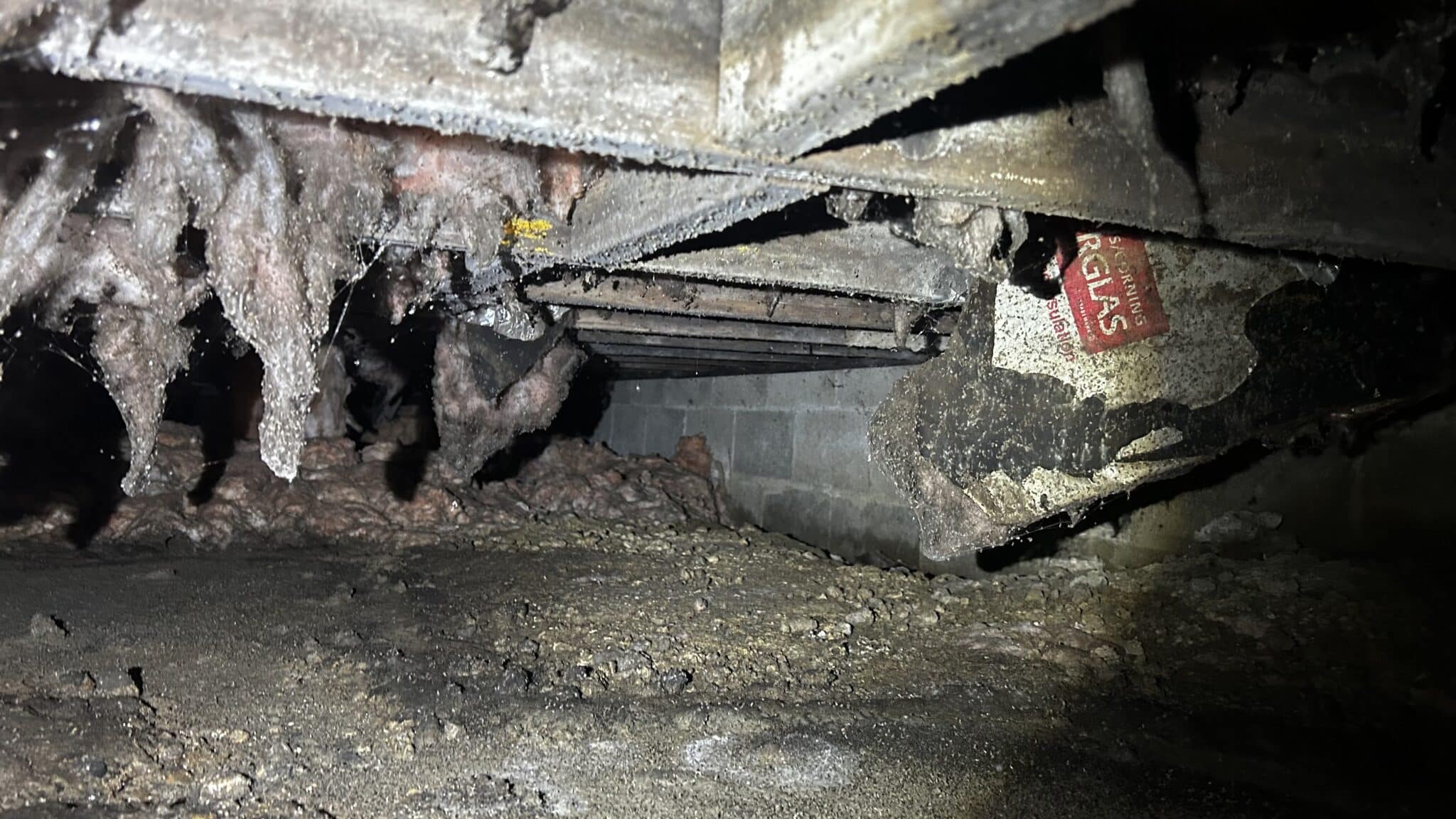
Crawl Space Mold Removal in Columbus — Real Project Photos
Real crawl space mold removal photos from a recent Franklin County job — the conditions found in Columbus homes built before 1980. Same-day inspection. Written scope before any work started. Humidity dropped from 89% to 64.7% the same day encapsulation was completed.

Crawl Space Mold Removal vs. Encapsulation — Which Do You Need?
Two different services solving two different problems. Most Columbus crawl spaces with active mold need both mold removal and encapsulation — in the right order.
Mold Removal (Remediation)
Removes existing mold from surfaces and structural materials.
Mechanical mold removal — wire brushing, HEPA vacuuming, soda blasting where appropriate. Followed by EPA-registered antimicrobial treatment. Addresses the mold that is already there. Required first if active mold is present in your Columbus crawl space.
Crawl Space Encapsulation
Seals the crawl space to prevent future moisture intrusion.
Heavy-gauge vapor barrier installed across the crawl space floor and walls. Blocks ground moisture from entering the space. A prevention measure — not a cure. Does not remove existing mold. Keeps humidity below the 60% threshold where mold actively colonizes.
Not sure which your crawl space needs? Call 614-810-0000 — honest assessment, no upsell pressure.
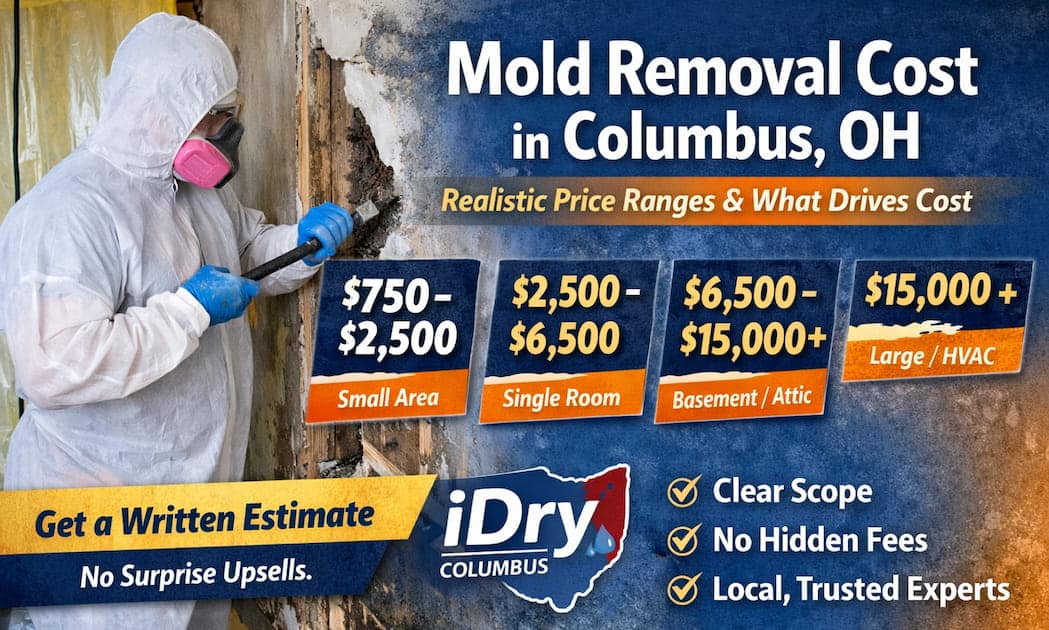
Crawl Space Mold Removal Cost in Columbus, Ohio
What does crawl space mold removal cost in Columbus? Honest ranges — and what drives the difference.
Minor Surface Mold
Limited surface mold on rim joists or vapor barrier. Single moisture event, caught early. No structural material removal required. Most straightforward crawl space mold cases in Columbus fall here — especially homes where a buyer's inspector found early-stage growth.
Moderate Crawl Space Mold
Mold covering 10–50 square feet of structural framing, subfloor, or multiple surfaces. Vapor barrier replacement typically required. Moisture source correction needed. Most mid-severity Columbus crawl space mold jobs fall in this range.
Severe or Chronic Mold
Extensive mold across the crawl space floor system, deep wood penetration, or long-duration growth. May require partial subfloor or joist removal. Encapsulation and drainage corrections often recommended to prevent recurrence. Full scope determined during free inspection.
All pricing ranges above are estimates. Actual crawl space mold removal cost depends on square footage, mold extent, structural material condition, and moisture source correction needed. The free inspection is the only way to get a real number for your situation. Call 614-810-0000 or submit the estimate form below.
Crawl Space Mold Health Risks — Why Removal Matters
Crawl space mold removal is not cosmetic — it's a health decision. The effects are real, dose-dependent, and well-documented. Here is what the research shows about exposure through a contaminated crawl space.
The stack effect makes crawl space mold a whole-house problem. Warm air rises through your home and exits through the roof. To replace it, air is drawn up from below — through your crawl space. In a home without proper vapor barriers, 40–60% of the air on your first floor can originate from the crawl space.
Active mold means you breathe mold. If that space contains active mold, you continuously breathe spores and mVOCs — the toxic gases mold releases as it grows.
Common health effects of mold exposure: Chronic breathing irritation, worsening asthma, persistent coughing, congestion, headaches, fatigue, and eye or skin irritation.
High-risk groups are more vulnerable. Children under 5, adults over 65, and anyone with asthma or a weak immune system develop symptoms at lower exposure levels. Black mold toxins can cause more severe breathing and neurological effects with heavy exposure.
The estimated percentage of first-floor indoor air that originates from the crawl space in homes without proper vapor barriers. Mold in the crawl space is not isolated — it affects the air your family breathes every day.
Columbus humidity compounds the risk. Central Ohio averages 70%+ relative humidity in spring and summer. Crawl spaces without vapor barriers or ventilation routinely see interior humidity above 80% — well above the 60% level where most mold actively grows.
Columbus clay soil keeps groundwater high, making seasonal moisture intrusion a reality for thousands of Franklin County homes. Crawl space water damage is often what starts the mold growth.
If you suspect mold exposure — see your doctor first. iDry Columbus is not a medical provider. The free inspection determines mold extent, species present, and the right removal approach. Call 614-810-0000 for a free crawl space mold inspection.
Helpful resources: Columbus mold remediation guide, water damage mold, and water damage restoration if active water intrusion is involved.
Crawl Space Mold Removal Across Columbus — Neighborhood Patterns
Thirty years of crawl space mold removal in Franklin County — every neighborhood has different construction patterns, different moisture problems, and different mold risks. This is what 30 years of local experience looks like.
Pre-1950 brick construction with original rubble stone foundations and no vapor barriers. Clay soil sits at or near grade level. These crawl spaces are perpetually damp — most German Village homes iDry visits have had mold present for years before discovery. We respond to German Village crawl space calls regularly.
1920s through 1950s construction — many homes with poured-concrete perimeter foundations and minimal crawl space clearance. Tree coverage creates constant shade over foundations. Combined with Columbus clay drainage, Clintonville crawl spaces see chronic moisture intrusion that becomes mold when vapor barriers fail or were never installed.
1960s ranch-style homes with crawl spaces that were built before modern vapor barrier standards. Many have partial plastic sheeting that has degraded or shifted over 60 years. When these barriers fail, groundwater wicks up through Columbus clay soil and moisture accumulates under the subfloor. Surface mold on joists is the typical finding.
1950s through 1970s construction with mix of slab-on-grade and crawl space foundations. Crawl space homes in Upper Arlington frequently have gutters and downspouts that drain too close to the foundation — directing water toward the crawl space rather than away. When combined with Columbus clay soil that holds moisture, seasonal mold issues follow.
Older Bexley homes (1920s–1940s) share the same construction profile as German Village — brick, rubble foundations, minimal crawl clearance. The established tree canopy throughout Bexley also limits sun exposure to foundations, slowing natural evaporation. We inspect Bexley crawl spaces regularly for both home sales and owner-discovered issues.
Newer Hilliard construction (2000s–2020s) typically includes proper vapor barriers and modern drainage. But punctured or poorly installed barriers are a common warranty issue.
We also see crawl space mold in Hilliard homes where HVAC drain lines empty into the crawl space — a slow moisture source that builds into mold over one or two seasons.
iDry Columbus responds to crawl space mold calls across all of Franklin County — including Dublin, Westerville, Gahanna, Reynoldsburg, Grove City, New Albany, Pickerington, Powell, and Grandview Heights. Call 614-810-0000 — the construction profile of your neighborhood is already familiar before the inspection starts.
Columbus Crawl Space Mold Removal Reviews
-
Kendra Turner ★★★★★
iDry Columbus went above and beyond in helping us with water damage. They were prompt and professional and thorough in making sure that everything was dry and that no mold could form.
-
David Warner ★★★★★
The owner came out personally to evaluate the damage. Old school & refreshing. His crew was professional and did an excellent job with the water damage and mold remediation. Highly recommend iDry Columbus.
-
Stacy Connelly ★★★★★
iDry Columbus did the job right. They found the mold source I couldn't locate, explained every step, and provided the clearance certificate I needed for my home sale. Would use them again without hesitation.
Crawl Space Mold Removal Resources — Columbus
-
Mold Remediation
Mold Remediation Columbus OH — Complete Guide
Everything Columbus homeowners need to know about mold remediation — process, cost, insurance, and how to choose a local company. Our full mold service hub.
-
Cost Guide
Mold Remediation Cost Columbus OH — 2026 Pricing
Honest cost ranges for every type of mold remediation in Columbus — basement, attic, crawl space, and full-home. Includes insurance and financing guidance.
-
Real Estate
Crawl Space Mold & Columbus Real Estate Transactions
Buying or selling a Columbus home with crawl space mold? We work with buyers, sellers, and agents — including tight inspection timelines and full documentation for closing.


Crawl Space Mold Removal Questions — Answered by Columbus Experts
Is mold in a crawl space dangerous to your health?
Yes — mold spreads throughout your home via the stack effect. Crawl space mold affects air quality in your Columbus home. Air drawn from below carries spores and mVOCs into your living space. Health effects: breathing irritation, worsening asthma, fatigue, and headaches.
Children and elderly residents face the highest risk. Call iDry Columbus at 614-810-0000 for a free assessment.
How much does crawl space mold removal cost in Columbus?
Costs run $1,500–$5,500+ depending on severity. Minor surface mold in Columbus crawl spaces typically runs $1,500–$3,000. Moderate cases covering 10–50 square feet of structural framing run $3,000–$5,500. Severe or long-duration mold with structural material removal starts at $5,500. Your specific cost depends on square footage, mold species, and moisture source correction needed. Free inspection determines the exact scope. Call 614-810-0000.
What causes mold in Columbus crawl spaces?
Ground moisture and failed vapor barriers are the top causes. The most common causes in Franklin County homes: failed or missing vapor barriers, poor crawl space ventilation, plumbing leaks onto the crawl floor, HVAC drain failures, and surface water from grading problems.
Columbus clay soil holds moisture near the foundation. That makes vapor barrier failure the number-one cause here. Call 614-810-0000.
Can I remove crawl space mold myself?
Not recommended for anything beyond minor surface growth. DIY mold removal should only be tried on small areas (under 10 sq ft). Crawl spaces need proper breathing protection and full containment to prevent spread.
DIY work without containment actively spreads spores. Real estate transactions require professional documentation of remediation. Call iDry Columbus at 614-810-0000.
Does homeowners insurance cover crawl space mold removal in Ohio?
Coverage depends on the cause. Ohio homeowners insurance covers mold when it came from a sudden event — burst pipe, appliance failure, or storm damage. Gradual moisture from drainage or vapor barrier failure is usually not covered.
iDry Columbus documents every job for insurance claims. Call 614-810-0000 and we'll explain your coverage options.
How long does crawl space mold remediation take?
Timeline: one to five days depending on severity. Minor jobs take one workday. Moderate cases — larger framing areas, vapor barrier replacement — take two to three days. Severe cases with structural removal: three to five days.
Call iDry Columbus at 614-810-0000 for a specific timeline estimate.
What's the difference between crawl space mold remediation and encapsulation?
Two different things — in the right order. Mold remediation removes existing mold. Encapsulation seals the crawl space with heavy-gauge vapor barrier to block ground moisture going forward.
Encapsulation does not remove mold — it traps it if done first. Correct order: remediate, then encapsulate. Call 614-810-0000 for the right approach.
How do I know if I have mold in my crawl space?
Watch for these warning signs: musty or earthy odor from floors and vents, visible black or white growth on floor joists (check with a flashlight from the access hatch), unexplained allergy symptoms, persistently high first-floor humidity, or flagged findings on a home inspection report. For real photos, see our mold identification guide.
If any of these apply, call iDry Columbus at 614-810-0000 for a free inspection.
Does crawl space mold affect home value in Columbus?
Yes — crawl space mold affects home value. A mold finding on a Columbus home inspection can affect the sale through price cuts, required repairs before closing, or buyers walking away.
Professional remediation with full documentation of completed work puts the home back on the market. iDry works with buyers, sellers, and agents across Franklin County. See our crawl space mold real estate page or call 614-810-0000.
Can crawl space mold be prevented from coming back after remediation?
Yes — if the moisture source is corrected. Mold returns when conditions allow: moisture above 60%, organic material, and warmth. Remediation removes existing mold. Long-term prevention requires correcting the source — vapor barrier installation, drainage improvements, or ventilation upgrades. Call iDry Columbus at 614-810-0000 to discuss prevention options.
Page published · Updated
Free Crawl Space Mold Removal Estimate — Columbus
Describe what you found and we will respond within the hour. For active health concerns or real estate deadlines, call 614-810-0000 directly — we work faster by phone.
Crawl Space Mold Removal — Serving All of Franklin County
Same-day crawl space mold removal response across all of Franklin County and surrounding areas. Thirty years of local experience across every Columbus neighborhood — the construction eras, the drainage patterns, and the mold species common to your area are already familiar before the inspection starts.