
Curtis Teets · 30-year Columbus restoration veteran.
Basement Mold Removal That Stops the Problem at Its Source
Columbus homeowners deserve mold solutions that work. We find where moisture enters, remove the mold safely, and keep it from coming back. Thirty years of basement mold expertise — no guessing, no shortcuts.

Locally owned. Thirty years of Columbus basement mold remediation. Every job owner-supervised. Call 614-810-0000 for your free assessment.
Why Columbus Basements Grow Mold So Easily
Columbus sits on dense clay soil that holds water against your foundation walls. Add seasonal humidity swings and condensation from temperature differences — your basement becomes the ideal environment for mold growth.
Time mold needs moisture before establishing a colony. Columbus basements provide everything else — food sources in drywall and framing, darkness, and poor ventilation.
Foundation moisture is the root cause. Columbus clay soil creates hydrostatic pressure — water pushing against your foundation from the outside. Block and poured concrete foundations both absorb this moisture through capillary action, which means moisture wicking through the concrete itself. Your walls can feel dry to the touch while feeding mold behind the surface.
Condensation compounds the problem. When warm summer air meets cool basement walls, moisture forms on every surface. Columbus summers push outdoor humidity above 80%, and your below-grade walls stay around 60°F. That temperature gap creates condensation — and mold needs just 48 hours of moisture to establish a colony.
Some Columbus neighborhoods carry significantly higher basement mold risk than others. Our Columbus Neighborhood Mold Risk Index ranks all 26 neighborhoods by environmental mold risk — FEMA flood data, housing age, soil drainage, and basement prevalence combined. If your area ranks Critical or High, a professional inspection is worth scheduling before problems start.
Seasonal patterns drive mold cycles. Spring snowmelt and heavy rains saturate the soil around your foundation. Summer humidity adds condensation. Fall leaf buildup clogs gutters and redirects water toward your walls. Columbus homeowners see the worst basement mold between April and October.
Water damage causes most basement mold in Central Ohio. Any unresolved moisture event — a slow leak, a storm backup, condensation buildup — creates the conditions mold needs. The faster you address the water, the lower the mold risk.
Gutter and grading failures accelerate everything. Downspouts that dump water within 4 feet of your foundation, negative grading that slopes toward the house, and window wells without proper drainage all funnel water directly to your basement walls. A failed sump pump turns a manageable moisture problem into a flooded basement overnight.
Is Basement Mold Dangerous? Health Risks You Need to Know
Yes — basement mold releases microbial volatile organic compounds (mVOCs) — gases you breathe every time air circulates from your basement upstairs. The EPA identifies mVOCs as a byproduct of active mold growth. Your HVAC system spreads these throughout your home.
Children are most vulnerable to mold exposure. The CDC reports that people with allergies or weakened immune systems may be more sensitive to mold. Young lungs are still developing. Exposure to mold spores increases asthma risk, triggers allergic reactions, and can cause chronic respiratory problems. A moldy basement directly impacts your family's health, not just your home's value.
Allergic responses compound year-round exposure. Basement mold triggers itchy eyes, nasal congestion, throat irritation, and skin rashes. Some people develop mold sensitivity over time — meaning repeated exposure makes reactions worse. If your family's allergies improved when you left home or worsened in your basement, mold could be the cause.
Black mold myth: color doesn't determine danger. Not all black mold is Stachybotrys, and not all Stachybotrys is "toxic black mold." What matters is mold presence, moisture, and duration of exposure. Green mold (Penicillium, Aspergillus) causes just as much respiratory damage as black mold. Basement mold of any color warrants professional removal.
HVAC mold contamination spreads the problem. When HVAC mold contamination takes hold, your air handling system distributes mold spores to every room in your home — bedroom, living room, kitchen. Ductwork running through your attic carries basement spores into upper floors. A basement mold problem quickly becomes a whole-house air quality problem.
Common Mold Types in Columbus Basements
Four mold species dominate Columbus basements — each with different identification markers and risk profiles. Knowing what you're looking at helps determine urgency and remediation approach.
White Mold / Efflorescence
ID: Powdery white mineral deposits on block or poured concrete — looks like mold but often isn't.
Risk Level: Low (if it's true efflorescence, not mold).
What to do: Mineral deposits (efflorescence) are harmless, but their presence signals moisture is moving through your foundation. If powdery substance is on paper-faced insulation, wood studs, or drywall — that's mold. Professional testing confirms which you have.
Black Mold (Stachybotrys)
ID: Dark greenish-black, slimy coating on materials that stayed wet for days — drywall, carpet, wood.
Risk Level: High — indicates sustained moisture and advanced colonization.
What to do: Requires professional removal with containment per EPA cleanup guidance. Often means affected materials must be removed and replaced. Never try DIY removal — spore disruption spreads contamination.
Green Mold (Penicillium / Aspergillus)
ID: Green or blue-green fuzzy growth, often on drywall, insulation, or HVAC ducts.
Risk Level: High — respiratory allergen and asthma trigger.
What to do: Professional containment and HVAC system cleaning required. More common than black mold but equally damaging to air quality.
Yellow Mold (Serpula)
ID: Yellow or orange patches, sometimes with white threads — attacks wood directly.
Risk Level: Structural hazard — wood-eating mold that weakens framing.
What to do: Professional structural assessment needed. May require wood replacement. Indicates chronic moisture problem requiring source elimination.
How We Remove Basement Mold: Our 6-Step Process
Six steps. Complete resolution. Every job includes post-remediation verification — we don't just remove mold, we prove it's gone.
Our process finds the moisture source, removes all mold safely, and prevents it from returning. Most contractors stop after removal. We continue to the source — fixing gutters, grading, drainage, or ventilation so the problem doesn't repeat.
Moisture Detection & Mapping
We locate every pocket of moisture — visible and hidden. Thermal imaging cameras and calibrated moisture meters find water inside walls, under floors, and in ceiling cavities. Your eyes can miss 80% of the problem.
Source Elimination
We identify why the moisture is there and fix it. Grading, gutter repair, downspout extension, sump pump installation, or drainage line correction — source elimination is the permanent fix.
Containment & Safe Removal
We set up HEPA-filtered containment to prevent spore spread. Negative air pressure keeps contaminated air from reaching other rooms. Affected materials are sealed, removed, and properly disposed. All work under strict containment protocol.
Deep Cleaning & HVAC Flush
Cleaned surfaces receive antimicrobial treatment, and your HVAC system is flushed of spores. We clean ductwork, replace filters, and verify no mold spores survived the remediation.
Moisture Control Installation
Dehumidifiers, vapor barriers, or ventilation upgrades prevent mold from returning. Prevention is the final step — controlling humidity below 50% is the only way to guarantee mold stays gone.
Post-Remediation Verification
We test air quality and document that all mold is gone — not just removed, but verified. Clearance testing confirms your basement meets EPA remediation standards.
What Does Basement Mold Removal Cost in Columbus?
Cost depends on severity — how much mold is present, how much material is affected, and whether the moisture source requires structural work. These are estimates. Actual cost varies by scope. See our full cost guide for detailed pricing factors.
Small Area
$500–$1,500+
Coverage: <10 sq ft of visible mold, isolated to one wall or corner, no structural material removal needed.
Moderate
$1,500–$5,000+
Coverage: 10–50 sq ft, drywall removal required, moisture source remediation (minor grading or gutter work).
Severe
$5,000–$15,000+
Coverage: 50+ sq ft, multiple rooms, major structural repairs, or major moisture source work (drainage system, foundation waterproofing).
Homeowners insurance typically covers mold caused by sudden water events — pipe bursts, roof leaks, basement flooding. Call 614-810-0000 and we help navigate your claim. See our insurance guide.
Insurance & Basement Mold in Ohio
Ohio homeowners insurance covers basement mold if it's caused by a sudden, accidental event — burst pipe, roof leak, basement flooding. If you've experienced water damage, mold remediation is often covered under the same claim. Chronic moisture or deferred maintenance typically is not covered. Coverage varies by policy — the Ohio Department of Insurance handles disputes. iDry handles the documentation your adjuster needs.
Typically Covered
- Mold from burst pipes or sudden water intrusion
- Mold from roof or gutter failure
- Mold from basement flooding (if sudden)
- Mold remediation and cleanup
- Affected structural material removal
Typically NOT Covered
- Mold from chronic moisture or poor ventilation
- Mold from deferred maintenance (ignored leaks)
- Mold from gradual seepage (not sudden event)
- Preventive treatments (waterproofing before damage)
- HVAC upgrades or dehumidifier installation
Where We See Basement Mold Most in Columbus
Columbus neighborhoods vary by construction era, foundation type, and soil composition — each presents different basement mold patterns. We've served all of Franklin County for 30 years. Here's what we see.
1920s–1950s block foundations with poor original waterproofing. Heavy rainfall and dense clay soil create chronic seepage. We remediate more basements in Clintonville than any other neighborhood.
Historic 1800s brick and stone foundations in a flood-prone area near the Scioto River. High water table makes these basements chronically damp. Preservation constraints limit modern waterproofing approaches.
1920s–1960s homes with mature tree root systems disrupting original drainage. Older foundation waterproofing deteriorates. April–May thaw and summer humidity create predictable seasonal mold cycles.
1920s–1940s estates with stone and block foundations on clay soil. Historic preservation constraints limit waterproofing options. Mold is a major issue in this neighborhood.
1940s–1970s homes with aging poured concrete and block basements. Limestone foundation areas have naturally high water table. Typical seasonal moisture problems.
1970s–1990s split-level and ranch homes with poured concrete basements. Sump pump dependency and poor subdivision drainage create active mold seasons. Spring and summer are predictable problem times.
Also serving: Hilliard, Powell, Gahanna, Pickerington, Grove City, Reynoldsburg, Dublin, Grandview Heights, New Albany — all of Franklin County and surrounding areas.
What Columbus Homeowners Say About iDry
-
Kendra Turner ★★★★★
iDry Columbus went above and beyond for my family when we had a water emergency. They responded quickly, communicated clearly through the whole process, and left our home in great shape. Curtis and the team treated us like family — not just another job.
-
David Warner ★★★★★
The way Curtis and his crew handled our situation was old school in the best way — honest, respectful, and thorough. They cleaned out years of buildup without judgment and left the property ready for renovation. Communication was clear from start to finish.
-
Stacy Connelly ★★★★★
We had a mold problem in our basement that two other companies failed to fix properly. iDry came in, identified the source of moisture, and remediated everything correctly. The musty smell is completely gone and the basement is dry. Professional, on time, and fair pricing.
Related Mold Resources
Basement mold connects to broader mold and moisture management. Use these resources to understand your options — and call 614-810-0000 if you need help now.
-
Cost Guide
Mold Remediation Cost Guide
Complete breakdown of basement mold removal costs in Columbus — from small areas to major remediation projects with structural repair.
-
Next Step
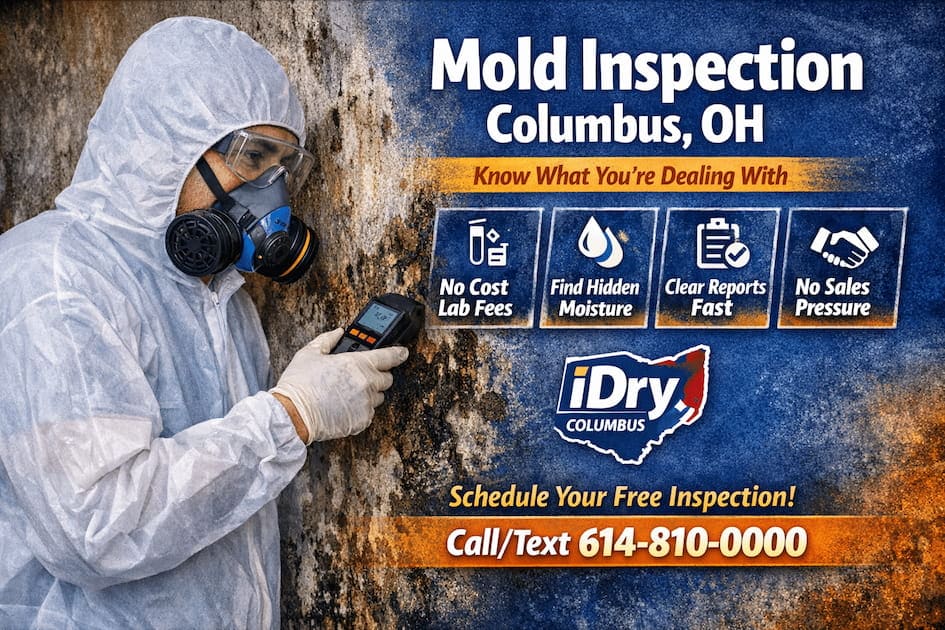
Professional Mold Inspection
What a professional mold assessment includes, how testing works, and what iDry's inspection process reveals about your basement.
-
Related Service
Crawl Space Mold Remediation
Below-grade mold problems — crawl spaces and basements share moisture sources. See how we address mold in restricted spaces.


Basement Mold — Frequently Asked Questions
Real questions from Columbus homeowners dealing with basement mold. Answered directly — no filler.
What causes mold to grow in basements?
Moisture is the root cause — from foundation seepage, condensation, poor drainage, or humidity. Columbus clay soil pushes water against foundation walls. Once moisture is present, mold needs just a food source (drywall, wood, carpet) and time. Basements provide all three. Call 614-810-0000 for a moisture assessment.
Is basement mold dangerous to my family?
Yes. Basement mold releases spores and mycotoxins that spread through your HVAC system to every room in your home. Long-term exposure triggers allergies, asthma, and respiratory problems — especially in children. Professional removal and moisture control are necessary for health protection. Call 614-810-0000.
How do I know if I have basement mold?
Warning signs: musty odor, visible black or green growth on walls or insulation, water stains, efflorescence (white powdery deposits), or condensation on windows and pipes. Hidden mold inside walls requires thermal imaging to detect. See real photos of mold to compare against what you're seeing. A professional mold inspection reveals what your eyes can't see. Call 614-810-0000.
Can I remove basement mold myself?
The EPA's mold cleanup guide notes that small areas (under 10 sq ft) may be manageable with proper PPE and containment, but larger areas or hidden mold require professional remediation with HEPA containment to prevent spore spread. Professional removal also finds and eliminates the moisture source — DIY typically addresses only surface mold. Call 614-810-0000 for guidance.
How much does basement mold removal cost?
Small areas cost $500–$1,500+. Moderate mold (10–50 sq ft) runs $1,500–$5,000+. Large remediation with structural repair costs $5,000–$15,000+. Cost depends on mold extent, material damage, and moisture source complexity. Insurance often covers sudden water events. Call 614-810-0000 for a specific estimate.
How long does basement mold remediation take?
Small mold remediation takes 1–3 days. Moderate projects take 3–7 days. Large remediation with moisture source work takes 2–4 weeks. Timeline depends on mold extent, materials to replace, and required drying time. iDry provides a schedule during the assessment. Call 614-810-0000.
Does homeowners insurance cover basement mold?
Yes — if mold results from a sudden, accidental water event like a burst pipe, roof leak, or basement flooding. Insurance typically does not cover mold from chronic moisture, deferred maintenance, or gradual seepage. iDry handles insurance documentation from minute one. Call 614-810-0000 to discuss coverage options.
What's the difference between mold removal and mold remediation?
Removal means cleaning or replacing moldy materials. Remediation means removing mold AND fixing the moisture source so it doesn't return. True remediation prevents future growth. iDry Columbus does remediation — we don't just remove what you see, we eliminate why it grew. Call 614-810-0000.
Will mold come back after professional remediation?
No — if the moisture source is truly eliminated and humidity stays below 50%. Mold returns only if moisture returns. iDry's process includes moisture source elimination and post-remediation verification. Selling your home? Crawl space mold affects real estate transactions — remediation protects your home's value. Call 614-810-0000.
How do I prevent basement mold from returning?
Keep humidity below 50% with dehumidifiers. Fix drainage issues immediately. Clean gutters and extend downspouts away from foundation. Ensure proper grading slopes away from the house. Ventilate after showers. Seal foundation cracks. iDry provides a prevention plan after remediation. Call 614-810-0000 to discuss options.
Get Your Free Basement Mold Assessment
Describe your situation and we'll call you back within minutes. For urgent mold concerns, call 614-810-0000 now — we provide same-day assessments.
Basement Mold Remediation Service Area — All of Franklin County
iDry Columbus responds across all of Franklin County and surrounding areas. 30 years of basement mold remediation across every Columbus neighborhood — we know the soil, the foundation types, and the seasonal moisture patterns unique to each area.